Oliebollenbroodschotel

Bread puddings, or broodschotels, as they are called in Dutch, occupied a steady section in older cookbooks, but as of late I don't see them as much, which is a pity. Especially nowadays, when frugality seems to be a wise choice, sweet or savory bread puddings may play a big role in providing sustenance for a small budget. The Dutch are traditionally big bread eaters, with usually two meals in the day consisting of bread, and on top of that we're pretty frugal, so it is not surprising that cookbooks from mid-last century had that many broodschotel recipes. The concept was easy: tear or slice up old bread, soak it in a mixture of milk and egg, add flavorings, and bake in the oven or in a frying pan, as is the case with wentelteefjes

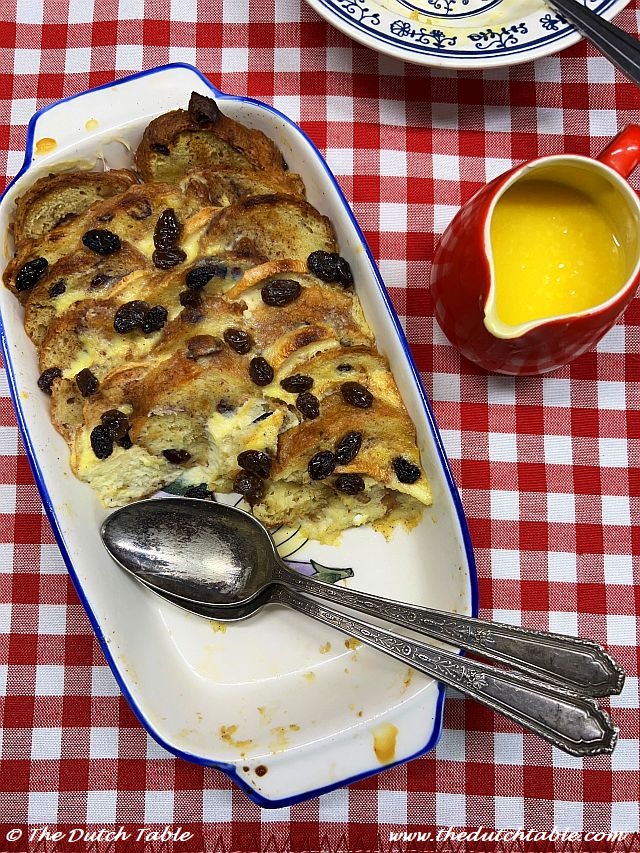
 "Wie wat bewaard, die heeft wat" said my oma Pauline triumphantly many times, "he who saves something, has something". She lived through the two wars and was resourceful and frugal, a quality that many of us will recognize in our parents and grandparents who lived through those times. Saving is one type of skill, and so is making leftovers into another tasty dish, so that food does not go to waste. And that is so true for today's leftovers, oliebollen from New Year's Eve. Oliebollen are best freshly fried, but make for a wonderful bread pudding. So, IF there are any left or if you have a chance to bake some extra and set them aside, this may be a great way to welcome the new year: bread puddings are a lovely treat for breakfast! 

And as with so many of our recipes, make this your own. If you like raisins, you can always sprinkle  them in with the sliced oliebollen, or add a chopped apple, dried apricots, or leftover cranberry sauce from your Christmas dinner, a handful of walnuts......as you can see there are plenty of opportunities to come up with a new family favorite!  

Oliebollenbroodschotel

8 oliebollen

1 tablespoon butter (15 grams)

1 cup (250 ml) milk

1/2 cup (125 ml cream)

2 tablespoons sugar

2 eggs

1 teaspoon vanilla essence

Optional: dried fruits, apple slices, vanilla pudding, cinnamon, powdered sugar

Heat the oven to 375F. Butter a casserole or baking dish. Slice the oliebollen and place them upright, alternating, in the casserole, so that they're nice and snug. Mix the milk with the cream and the sugar, and warm slightly on the stove, stirring until the sugar is dissolved. Remove from the stove, let it cool down to lukewarm, beat the eggs and stir into the milk, together with the vanilla. Pour over the oliebollen in the dish, but make sure that the liquid stays beneath the casserole line. 

Bake on a baking tray for 25 - 30 minutes. As the top oliebollen stay exposed (and crisp up) you may want to check after 15 minutes to make sure they're not burning. If they are getting too dark, cover the dish with aluminum foil. 

Sprinkle with cinnamon, and/or powdered sugar, or serve with warm vanilla pudding or custard. 


Staphorster Fleeren

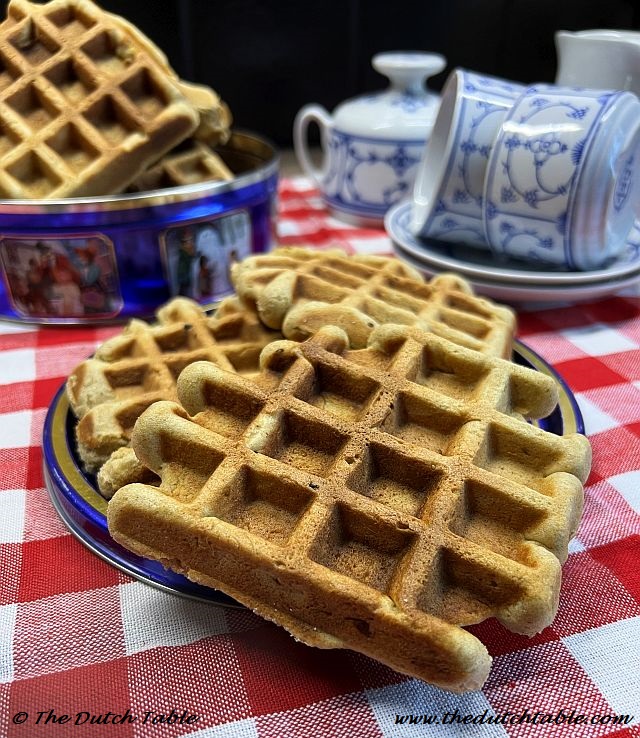
Dutch Anise Seed Waffle
I love how in the small country of the Netherlands (16,000 square miles, just a tad bigger than Maryland in the US), there are still so many regional differences in food and traditions, especially on festive days. We have just seen and enjoyed our New Year's Eve traditional foods, like oliebollen, appelbeignets, kniepertjes and so on, and now, on New Year's Day we welcome another set of traditional treats, many with a significant meaning. For example, the open crispy waffles called kniepertjes (from knijpen, to pinch, indicating the way the dough is pinched between the waffle irons) that is traditional in de Achterhoek area, on the east side of the country, is now served rolled up into a tight tube, and are called rollegies (from rollen, to roll). The kniepertjes symbolize an open book, and is therefore served on New Year's eve, when the whole past year has been lived out and does not hold any more surprises. Rollegies in turn represent a wrapped up, closed book, one that still has to reveal what is in store, and is therefore served on New Year's Day, January 1st. Isn't that a lovely thought? 

Today's waffles, Staphorster Fleeren, come from Staphorst, a small village in the province of Overijssel, east of Amsterdam and bordering Germany. Traditionally, they were served on New Year's Day, with a strong cup of coffee or tea. These are sturdy waffles, made with rye and wheat flour, an egg, some milk, and anise seeds. My first thought was that the rye made for a good stomach filling, and that the anise would soothe any possible, let's say, discomforts, from too much partying the night before. That is just my theory, of course, but it seemed like a good one. Its sparse and basic recipe also reflects a little bit the philosophy of the Staphorsters: they have a strong faith, falling somewhere between Calvinism and Lutheranism, and generally do without too much fancy stuff. Oddly enough though, I read in an older cookbook, the name "fleeren" means "slapping", and it's said that the waffles have to be soft enough to slap somebody in the face with. Well! 

I am not going to promote using these waffles to inflict harm on anybody, especially not on New Year's Day, but I can highly recommend them as a sturdy, stomach-soothing start of the day. The rye makes for a chewier waffle, the anise is comforting. Save the waffles in a cookie tin so that they remain soft. For an early breakfast, I also liked them with a lick of butter (but don't be telling anybody). 

Staphorster Fleeren

1 cup (125 grams) rye flour

1 cup (125 grams) all-purpose flour

1/4 cup (65 grams) brown sugar, packed

1 heaping teaspoon anise seeds

1 teaspoon baking powder

1/2 stick (50 grams) butter, melted

2 eggs

1/4 cup (100 grams) pancake syrup

1/2 cup (125 ml) milk

Mix the two flours, and add them to a bowl. Stir the sugar, the anise seeds, and the baking powder into the dry mix. In another bowl mix the melted butter, the eggs, the pancake syrup and the milk, then fold the wet into the dry mix. Stir well until all lumps have been removed. Rest the thick batter for about 15 minutes, then heat up the waffle iron. Scoop the dough onto the hot plates, bake the waffles until light brown, and serve warm. Save in a cookie tin to keep soft. Makes 8-10 waffles.


Berliner Bollen

There is nothing new about Berliner bollen, these Berlin doughnuts, as their recipe has been circulating around the northern parts of Germany since the 16th century, but there is something intriguing about them: any and all countries that fry these delicious, jam-filled treats call them Berliner doughnuts, except for the people of Berlin, who call them Krapfen or Pfannkuchen (literally pancakes). That in itself is confusing as we know pancakes to be very different to what we're looking at here. And so does the rest of Germany, who call pancakes pancakes, except for the Berlin people who call them Eierkuchen, egg cakes. And of course in the Netherlands, we know egg cakes to be eierkoeken, which is a totally different thing altogether. I guess it pays to know what certain foods are called locally when you have your heart set on something specific! 

Berliner bollen are traditionally eaten for New Year's Eve, as well as at Carnival. They eventually made their way to the US and can be found under the name Bismarcks, especially in the Midwest. As for fillings, they can be found with any kind of jam filling: cherry, raspberry, strawberry, apricot...But they can also be split in half and filled with pastry cream, or whipped cream and fresh fruit. Speaking of fillings, for April Fools, sometimes the Germans randomly fill several bollen with mustard and place them among the jam-filled ones. "Rare jongens, die Germanen", would Obelix have said! 

Now, you may ask, why am I reading about German food on a Dutch recipe website?  Well, because as is a neighboring country, Berliner bollen are a staple at any good Dutch bakery and definitely a favorite memory of my childhood in Limburg. Ours were always filled with apricot jam which, because of its tartness, has a nice way of cutting through the sugar and grease of the dough itself. And it's perhaps of our proximity to Germany, we also celebrated New Year's with Berliner bollen, next to the oliebollen and appelbeignets. So in case you've got some extra time on your hands, and you're firing up the fryer anyway, why not make a couple of these as well? You probably have all the ingredients at hand already, it's an easy recipe and it provides another variety to the table. 

Berliner Bollen

2 cups (300 grams) all-purpose flour

1 Tbsp sugar

1/2 tsp salt

1/2 cup (125 ml) warm milk

1.5 tsp dry yeast 

2 eggs

4 Tbsp (50 grams) butter, room temperature

2/3 cup (150 grams) sugar

3/4 cup (200 grams approx.) jam 

Optional: piping bag with pointed pastry tip

In a bowl, mix the flour with the sugar and salt. In a separate bowl, proof the yeast with the warm milk for a few minutes, until the yeast gets frothy. Stir in the milk and the eggs with the flour, give it a good stir until the dough comes together, and then knead in the room temperature butter. Knead for a good two to three minutes, until you have a soft dough. Form into a ball, and let it rest, covered until doubled in size. 

When doubled in size, divide the dough into ten 2 oz pieces (approx. 60 grams each) and roll them into balls. Cover again and let rise until doubled in size. When they're ready, heat up the deep fryer to 330F/170C and carefully lower the dough balls into the oil. Fry them on both sides for about 2 to 3 minutes or until golden and remove from the oil. Let drain on paper towels. 

When they've cooled down a little bit, pour the sugar in a bowl, and roll the Berliners through the sugar. Fill a piping bag with jam, and fill each doughnut with jam. If the jam is too thick to make it through the pastry tip, thin it with a little bit of water. Alternatively, you can cut the doughnut in half, and spread the jam in between the two halves. 


Sneeuwpudding

 It's no secret that we're a country set on dairy. A quick glance at the table of content from a random Dutch cookery book I pulled off the shelf puts us at over 200 different recipes for pap, pudding, vla and other dairy based dishes - easily. Well, and who can blame us? With so many dairies, and dairy cows, it's no wonder milk and its derivatives are a solid base on which we rely. 

I also believe we like these kinds of dairy dishes because they are easy to make, versatile, and look good at a breakfast table, after a big meal, or as a treat in between. Furthermore, they provide a great last-minute resource for unannounced visitors, surprise mee-eters (people who stay for dinner but who you had not counted with), or for a sudden attack of the munchies. Even better yet, you probably have most of the ingredients already! 

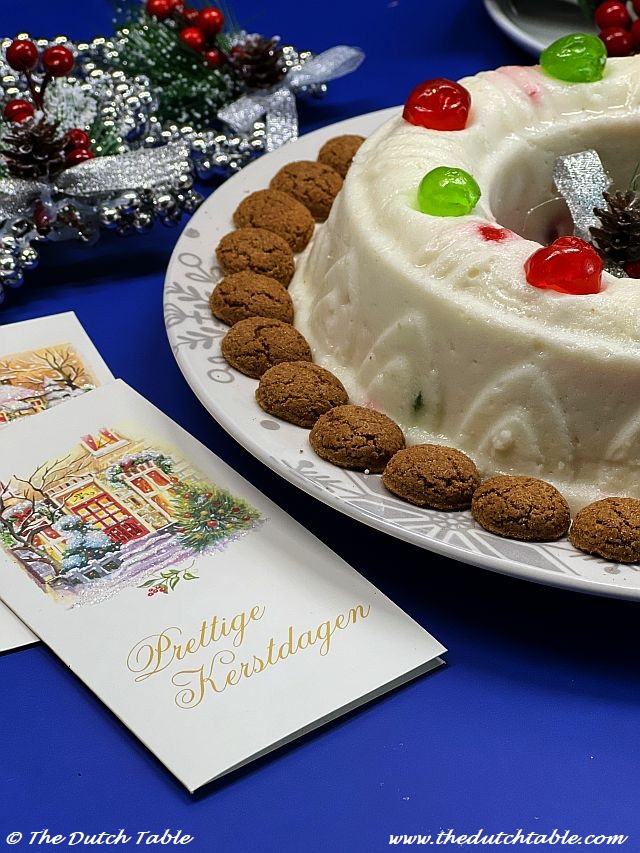
Today's dessert is called sneeuwpudding, snow pudding, a reference to its milky white appearance. I love the fact that it is in itself satisfying enough, but is at the same time a blank canvas for your own interpretation. As we're gearing up towards Christmas, I outfitted the sneeuwpudding with green and red cherries, but you can do the same with chocolate, fresh or dried fruit, or experiment with different colors. This is however a pudding that is best eaten the same day, as the cornstarch tends to release liquid after being a night in the fridge, which causes the pudding to "weep". It doesn't alter the flavor, but it doesn't look as appetizing. 

So, give it a go! 

Sneeuwpudding

3 cups (750 ml) milk

3/4 cup (100 grams) cornstarch

4 egg whites (4 oz/120 grams) - if possible, use pasteurized

1/2 cup (100 grams) sugar, keep one tablespoon separate

2 teaspoons vanilla, clear if possible

Pinch of salt

Strip of lemon peel

12 red cherries, chopped - keep 2 red cherries aside

12 green cherries - keep 2 green cherries aside

Optional: cookies to decorate

Rinse your pudding mold (should hold approx. 6 cups/1.5 liter) with cold water, and set it in the fridge until you are ready to use it. 

Toss the chopped cherries with the tablespoon of sugar so that all sticky sides are coated. 

Stir half of the milk into the cornstarch and whisk out all the lumps. In a heavy bottomed sauce pan, heat the rest of the milk with the sugar, the strip of lemon peel and the pinch of salt. As the milk warms up, add in the cornstarchy milk and stir it together. Heating milk can be tricky, and often a brown layer will set on the bottom of the pan - you may want to use a silicon spatula to continue to stir the milk, or a wooden spoon, and not stir too vigorously. It's better to bring to a boil low and slow. 

In the meantime, whip the egg whites until they form stiff peaks. As the milk begins to boil, it will thicken into a thick paste. Continue to stir and cook for two to three minutes, then remove the lemon peel, and add the vanilla. If you can draw a groove into the paste with your spoon, and it does not immediately fill back in, it's done. Pull the pan from the stove. Fold in the beaten egg whites. Take the pan back to the stove, and give the sauce a few more folds, and finally add in the chopped cherries. 

Rinse the pudding mold again with cold water, and pour in the pudding. Set aside to cool, then refrigerate. If the exposed pudding is cool to the touch, cover it with a piece of plastic film to avoid drying out. 

Let it set in the fridge for at least 4 hours. When ready, remove the plastic, and turn over the mold onto a prepared plate. Halve the cherries you kept aside and cookies (optional) and decorate to your liking. 

Serve cold, and eat the same day. Serves 8. 


Karnemelksepap

It is probably not surprising to read that the Dutch dairy industry is in the top five of the world's largest exporters, generating close to 7.5 billion euros a year. Up to sixty five percent of its dairy is sent outside of the country borders, with cheese and powdered milk being the main product. And the 35% that stays in the country is divided up in cheese, milk, butter, vla, yogurt, and buttermilk. Our most famous product is cheese, of course, and our most unique one our vlas. And it's still not uncommon to see people drinking a glass of karnemelk, buttermilk, with their bread lunch, or as a refreshing and rehydrating choice on a hot summer day. 

But buttermilk is not to everyone's liking, with its sour taste and thick consistency. Whereas milk, vla, and yoghurt have advanced and are now available in many flavors and with added benefits such as extra calcium, vitamin D, or probiotics, karnemelk has pretty much stayed the same - and is slowly losing market share to all the new fancy flavors. Which is unfortunate, really, because buttermilk doesn't need any additions: it contains all the essential amino acids for the body, as well as calcium, vitamin B6 and B12, and generally contains less lactose than regular milk. Karnemelk also contains less fat than milk, and is beneficial for your intestinal system. 

Besides a beverage, karnemelk is also used for various desserts, like this delicious karnemelkpudding. It is also the main ingredient for this old-fashioned but very versatile dish: karnemelksepap, or buttermilk porridge. A slightly sour porridge, thickened with flour, and sweetened with a little bit of sugar, honey or syrup, the porridge is a blank enough canvas to adjust it to your own liking. It can be eaten hot for breakfast or lunch, and hot or cold as dessert. One combination that is popular with the farming community in the North is the so-called "zoepenbrij", where buttermilk is often mixed with whole grains, like cooked barley, or oats. In that case, omit the flour, as the grains will thicken the porridge. 

The key to making this dish is to keep a close eye on the buttermilk and not let it boil too high, as the buttermilk will curdle. Constant stirring will help. Makes four regular servings, or two large ones! 

Karnemelksepap
4 cups (1 liter) buttermilk
1/2 cup (75 grams) regular flour
Pinch of salt
Sweetener to taste (brown sugar, honey....)
Nuts, berries, and/or chopped fruit to your liking

In a small bowl, mix the flour with enough buttermilk to make a pourable, thick batter. Heat the rest of the buttermilk in a thick bottomed pan at medium low heat, stirring frequently. Don't let the milk come to a high boil, just an occasional bubble that breaks the surface. Stir in the flour mix and keep stirring until it's absorbed. Add the pinch of salt. Increase the heat to medium high, and continue to stir until the porridge thickens, and more bubbles come to the surface, for a few minutes. Any time you see a light yellow, watery streak in the porridge, it may mean that it's about to curdle, so pull the pan from the heat and continue to stir. 

When the porridge has thickened, pour into bowls. Top with sugar or honey, and add a handful of nuts and frozen berries, or seeds. 


Oubliewafels met slagroom

Summertime is Kermis time! If you grew up in the Netherland as a kid, at some point or another the kermis (fair) would have come to town. The zweefmolen (merry-go-round), reuzerad (ferris wheel), the botsautootjes (bumper cars), and the rups (the caterpillar) were popular choices, the latter especially with young couples as a green canopy would close over the cars, allowing the teenagers a quick kiss away from prying eyes. 

All those gravity and g-force defying attractions were lost on me however, as the first things I would seek out is the gebakskraam (the pastry booth), the snoepkraam (the candy booth) and the schietkraam (the shooting gallery). If the gebakskraam had oubliewafels and oliebollen, if the snoepkraam had giant spekkies (marshmallows) and wijnballen (large hard red candy globes), and if the shooting gallery had tin cans as targets (they were a lot easier to hit, guaranteeing me a stuffed toy or a goldfish!), it was a great funfair in my eyes! 

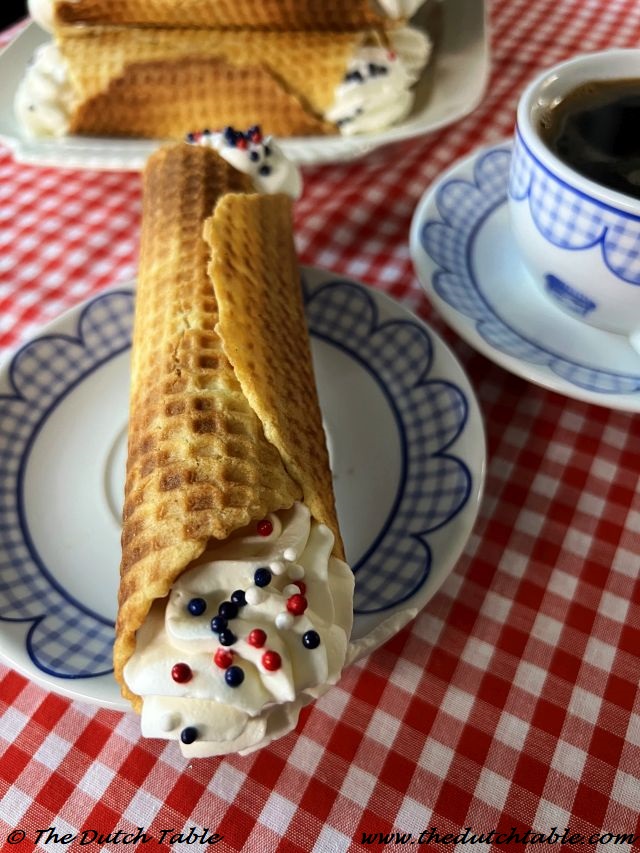
I was reminded of those grand times when I read that the Kermis, as a culture, had been added to the ever growing list of Dutch cultural heritages. Memories came flooding back, and I instantly had a craving for oubliewafels from the gebakskraam at the fair: crispy, sweet waffles rolled into a large tube, and filled with sweet whipped cream. These fall into the category of tricky-pastries-to-eat, like the tompouce or the Bossche Bol, because one bite into the waffle may cause the cream to shoot out the other end, so you've been warned ;-) 

The oubliewafels are rolled a bit larger than rollegies, for example, so find a handle, or dowel with a larger circumference, approx. 1 inch (approx. 2.5 cm). You will need a waffle iron for ice cream cones or pizzelles. 

Oubliewafels met slagroom

6 tablespoons (85 grams) butter (soft)
1 cup (200 grams) sugar
1 teaspoon vanilla flavoring
2 eggs
2 cups (250 grams) flour
2 cups (500 ml) heavy whipping cream
1/2 cup powdered sugar

Optional: colored sprinkles

Cream the butter with the sugar until it's pale and fluffy, about five to six minutes, at medium speed. Add the vanilla flavoring, and add one egg at a time until it's absorbed into the mix. Fold in the flour a few spoonfuls at a time until the dough is soft but homogenous. 

Divide into ten equal pieces (easier if you have a scale!), and roll into balls. Place on a plate, cover and put in the fridge for about half an hour. 

Heat the waffle iron. Place one dough ball above the middle line, towards the back of the iron and press down carefully, until the dough has spread into a large circular waffle. Bake according to manufacturer's instructions, but it usually doesn't take very long for the waffle to be golden and crisp, about a minute. 

Quickly remove the hot waffle from the iron (I use a large silicon spatula to lift it off the hot plate), and roll the waffle around the handle or dowel - do it fast because as the waffle cools down it becomes hard! Press the dowel lightly down onto where the two ends meet, so that you get a little bit of a flat bottom and the ends stick together. Let it cool for a second or two, and then slide the waffle tube off the dowel. Set aside to cool. Make the rest of the waffle tubes. 

When you are ready to serve, whip the cream into stiff peaks and fold in the powdered sugar. Add it to a piping bag with a star tip, and fill the tubes. Use the tip to make a pretty rosette on each end, and top with the colored sprinkles (optional). Stack the waffle tubes on a pretty plate and serve immediately - the moisture in the whipped cream will slowly soften the waffle, making it harder to eat. 

Makes 10. 


Paasstol

"
Een ei is geen ei, twee ei is een half ei, drie ei is een Paasei!" goes a famous Dutch children's verse. We're getting ready to celebrate Pasen, Easter, with plenty of eggsaladPaasbroodPaashaasjes or even a beautiful Paastaart, an Easter cake, complete with advocaat

Not to be outdone by anyone, we celebrate Easter for two days. The first day is Easter Sunday, or First Easter Day, Eerste Paasdag. The gathering of family and friends around the breakfast, lunch, or dinner table is key on First Easter Day. Stores are closed, and children are dressed in their "Paasbest" (Easter Best) with new clothes and shoes. All the eggs are dyed in bright colors, hidden and if lucky, all found. The breakfast or brunch table will be laden with different types of bread (multigraintiger rolls, currant rolls), as well as omelets, smoked salmon, cold cuts, and cheese, and plenty of hot coffee and tea. This is not a time to rush, but to enjoy each other's company, and several times the breakfast turns into brunch which then turns into lunch. As long as it's gezellig

And as the world gets back to work and resumes normal life on the Monday after Easter, the Netherlands celebrates Second Easter Day, or Tweede Paasdag. Where most stores and businesses remain closed, Second Easter Day is seemingly THE day to go furniture shopping. The large furniture stores, meubelboulevards, are open to the shopping public. Some of these are all set up for a fun day: playgrounds for the kids and a tearoom or lunchroom for mom, to make it gezellig

And if you're skipping brunch or have friends and family over for coffee or tea later, you can also serve something sweet: a Paastaart, or Easter cake, a variation on our traditional slagroomtaart, whipped cream cake. Decorated with fluffy whipped cream, a light biscuit batter and an adult amount of advocaat, this Easter cake will put a smile on your face. 

Today's Paasstol will look very familiar to those who like to celebrate Christmas with a kerststol, a dried fruit studded bread with a thick ribbon of almond paste, and covered in powdered sugar. Both share the same recipe and sometimes even fillings: the only difference is that at Christmas we top the bread with powdered sugar, at Easter we sprinkle it with shaved almonds. But hey! if you prefer powdered sugar to apricot jam and nuts, go for it. If you don't like raisins, don't put them in - just substitute the amount with a different dried fruit. It's all good! 

Paasstol is best eaten with a generous lick of butter. Whip the almond paste out of the slice, and spread it on top of the butter. The bread is also really good toasted!

Paasstol

1/2 cup (75 grams) golden raisins 
1/2 cup (40 grams) mixed and chopped dried fruits, like cranberries, currants, cherries, dried apricots...
1/4 cup (60 ml) orange juice, warm  - some prefer rum or a flavored liqueur
2 1/2 cups (350 grams) all-purpose flour 
3/4 cup (175 ml) milk, warm 
2 teaspoons (7 grams) active dry yeast 
1/4 cup (55 grams) sugar 
1/2 teaspoon (4 grams) salt 
1 egg, beaten 
1/2 stick (50 grams) butter, melted 
1 teaspoon lemon or orange zest

For the filling:
1 small can of almond paste* (or make your own

For the finish:
2 tablespoons butter, melted (25 grams)
1 tablespoon apricot jam, mixed with 1 teaspoon hot water
1/2 cup (50 grams) slivered almonds 

Soak the raisins and the dried fruits in the warm orange juice for a good fifteen minutes, then drain. Spread them out in a colander or baking sheet so that they can air-dry while you continue with the recipe. 

In a large bowl, place the flour. Make a well in the center and pour the warm milk in, and sprinkle the yeast on top. Let it sit for five minutes. Stir the flour and the milk until it barely comes together. Add the sugar and the salt, stir again, and slowly add the egg, then the melted butter and the citrus zest. Continue to knead for ten minutes on medium speed, until the dough comes together. 

Let the dough rest at room temperature, covered, for thirty minutes. Give those dried fruits a quick squeeze to drain some superfluous liquid. Punch the air out of the dough, and pat it flat on the counter, spread the dried fruits over the top, and carefully knead the dough back together into a ball, either by hand or in your bread mixer, but be careful that you don't tear up the fruit! You'll probably have more dried fruit than you think will ever fit, but keep kneading and pushing them back in the dough (they tend to escape).  Knead the dough carefully until the fruits are well distributed. Grease a bowl, place the dough inside, cover, and rest for an hour at room temperature or until the dough has doubled in size. Don't skip this step as the stol will be very thick and heavy if you do. 

Gently deflate the dough and pat into an oval. Place the oval with the short end
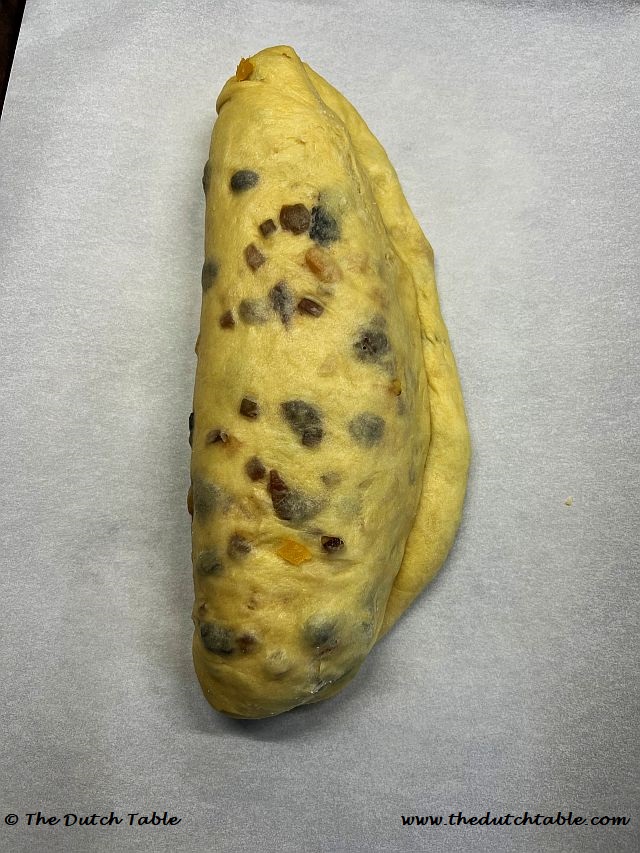
toward you and make an indentation along the length of the dough, in the middle. Now roll the almond paste on the counter until it forms a roll almost as long as the dough. Lay the almond roll in the indentation and lift the left side of the dough over the paste. Make sure that the dough does not meet the bottom half all the way on the right: a significant shape of the stol is the bottom "pouting" lip of the bread. Gently press the edge of the top half into the dough at the bottom.

Rest the dough on a lightly greased baking sheet or a silicone mat. Cover it, and let it proof for about 30 minutes or until ready to bake: the dough should barely spring back if you poke it with your finger. In the meantime, preheat your oven to 350F/175C. Bake the bread for 35 - 40 minutes on the middle rack. If the bread is browning too fast, cover it with a piece of aluminum foil. Use a digital thermometer to determine if the bread is done: the temperature should be 190F/88C and rising.

As soon as the bread comes out of the oven, brush it with the melted butter. Cool for about 15 minutes, then brush the bread with the apricot jam. Sprinkle the almond shavings on top. Wait until the bread is fully cooled down before slicing. Best served with a generous lick of butter!

Tip: If you have any paasstol left over the next day, toast a slice until nice and golden. Whip the almond paste out with the tip of your knife and spread it on the warm slice of bread. Yummm!!!!!!!!!

Vrolijk Pasen everyone!


Vijfschaft


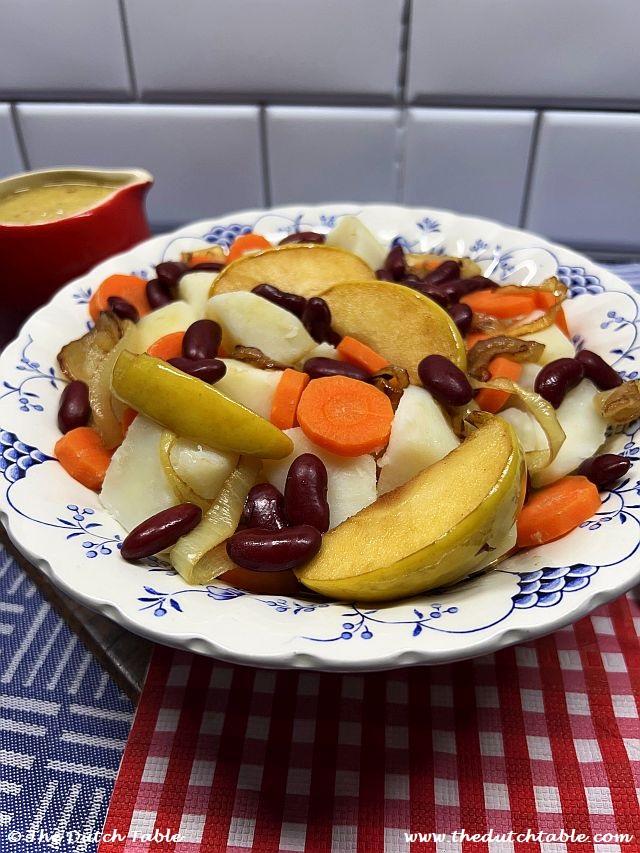
 As you can imagine, I do a lot of reading. Cookbooks, history books, and anything else that can help me dig deeper into our Dutch food culture and our traditions. And very often I can find background information that helps me place a dish in a certain province or timeline. But the information for today's dish, Vijfschaft, eludes me. For one, there are as many variations as there are recipes. The only constant is the main ingredients: potatoes, carrots, onion, apple, beans. Secondly, it is said to be a typical dish from Utrecht...but I can't find the source. I've gone back as far as 1769 but there is no mention. Every recipe intro says the same thing: the name is unknown, it is eaten during the time of year when there was not much left of the foods stored over the winter, it was eaten during the time that there was not much farming to be done (i.e. winter), and the name "vijf" (five) either refers to the five main ingredients or dinner time, and the word "schaft" (worker's meal break) indicates the worker nature of the dish.

I can see why this dish would be suitable for workers: it is loaded with carbs which provide plenty of energy. The ingredients are also easily found and prepared: apples, onions, potatoes, and carrots are ingredients for many a stamppot, and brown beans are the main ingredient for a delicious soup. 

Because I can't really vouch for the recipe's origin, background, regional impact, or significance, there is a good side: we can make the recipe our own, and nobody can tell us we're doing it wrong :-)  The premise of the dish is that the five cooked ingredients are added to a deep bowl or dish, seasoned with salt and pepper. The two main variations seem to be that you can: 

- boil all the ingredients in bouillon or water.

- fry the onions and the apples in butter, boil the potatoes, beans, and carrots. 

From here on out, it's a free for all. You can mash the boiled ingredients roughly, with a bit of butter and some of the cooking liquid, warm milk, or appelmoes and eat it like a coarse stamppot. You can leave the vegetables whole and serve it with the cooking liquid (more like a stew), or thicken the cooking liquid and season it with mustard and pour it over before mixing it in. Or you can serve it with a dollop of butter or mayonnaise. You can also add rookworst, smoked sausage, and/or bacon. See what I mean? Many variations of the same dish - so it's all up to what you prefer! As for me, I like it two ways: either hot, with smoked sausage, with a mustard sauce, or cold the next day, chopped up and mixed with mayo, more like a potato salad. Below is the recipe for the hot dish. Serves 4. 

Utrechtse Vijfschaft

4 medium-sized potatoes, peeled and quartered

1 vegetable bouillon cube

1 large carrot, peeled and sliced

1 small can brown or red kidney beans (approx.8 oz/ 250 grams), drained and rinsed

1 smoked rope sausage

1 large onion

1 large apple

2 tablespoons (30 grams) butter

2 tablespoons mustard

1 tablespoon cornstarch

Salt, black pepper

Bring the potatoes to a boil in enough water to cover, with the bouillon cube for about 10 minutes. Turn to simmer, and add the carrots, the rinsed beans, and the smoked sausage and slow boil for 10 minutes more. Check to see if the potatoes are done, then drain, but reserve a cup (250 ml) of the cooking water. 

In the meantime, peel and slice the onion in rings, core the apple, and slice into 8 slices. Melt the butter in a skillet and brown the onions, for about ten minutes on low-medium heat. Add the apple slices and fry them brown on each side, for about five minutes. Turn off the heat and set it aside. 

Mix the cornstarch with a tablespoon of cold water. Bring the cooking water to a boil, mix in the cornstarch slurry and stir until it thickens, about a minute. Turn down the heat and stir in the mustard. Taste to see if you'd like a stronger mustard taste, if so add another tablespoon. 

Mix the potatoes, carrots, beans, fried onions, and apple in a large bowl. Taste and see if you need to adjust the salt. Sprinkle freshly ground black pepper over the dish. Serve the warm mustard sauce on the side, together with the sliced sausage.