Soepballetjes

"Geef mij maar soep, soep, soep met balletjes
" sang Rita Corita already in the 50's, and for those of you who listen to the Groeten Uit Het Zuiden podcast from Jordy Graat and Rob Kemps, may remember that last season's soup component started with the "Soep met Ballen" song by Leo van Helmond. 

Even the sheep Veronica, a fantastic poem by Annie M.G. Schmidt, brings up "soep met ballen", soup with meatballs, as a delightful, delicious, start of a dinner. It is truly an engrained and traditional addition to our kitchen, to our many soups, and delights many, young and old. 

So what are these soepballetjes? That's an easy answer: small meatballs that are added to traditionally tomato or vegetable soup, but they can also be added to other soups. Beyond that there is a vast choice of flavors, combinations, and options.  Commercially, soepballetjes can be bought pre-made and blanched in jars with bouillon, in cans with salted water, and in the meat section at the grocery store or at the butchers you can also buy them pre-seasoned and raw. 

We have soepballetjes made with beef, with half-om-half (half beef, half pork), made with chicken, turkey, or vegan. They come with different seasonings and in different variations. I've seen people use, outside of salt and white or black pepper, any combination of onion powder, nutmeg, coriander, ginger, mace, cardamom, chili powder, paprika, bay leaf, and a whole host of dried spices: parsley, thyme, oregano....

And then of course there are the soepballetjes made at home, where those who do make them, have their own family recipe or preferences. Some make them fresh while making the soup, others make a big batch every now and then (a fun family affair!), blanch and freeze them, still others fry them first so that they get some color. Some make them small, others make them bigger. Some only use meat, others add breadcrumbs or egg. All this to say that there is no "official", one way to make soepballetjes. But if you've never made them before and would like to give it a try, here's a very basic recipe. 

I make mine ahead of time by cooking them in bouillon and storing them in a container in the freezer. That way, when I make soup, I just grab a handful and add them last minute. The following recipe makes about 90 soepballetjes (I portion mine out at 5 grams, 0.2 oz). 

Soepballetjes

8 oz (225 grams) ground beef
8 oz (225 grams) ground pork
2 tablespoons bread crumbs
Salt
Pepper
Optional: nutmeg
1 bouillon cube of choice

Mix the two meats together with the breadcrumbs, and season with salt and pepper. Put a pot on the stove with 4 - 6 cups (1 - 1.5 liter) of water, add the bouillon cube (I use vegetable bouillon), and bring up to a low simmer (do not boil). Use a small ice cream scoop (mine is 1 teaspoon sized) to portion the meat and roll one or two mini marbles, as a tester. Add to the simmering bouillon. They will sink to the bottom first, and as they cook, float to the top. Remove the tester and taste. Adjust the seasonings to your liking, but remember that the flavor should not overpower the soup they're going to be in. 

Continue to portion out the meatballs. I make them fairly small, at 5 grams each (0.2 oz) but that is purely a personal preference, so go with what you feel is the right size for you. Simmer them in the bouillon, and remove them a few minutes after they float. Spread out on a baking sheet, cool, and then freeze them. Once frozen they can be kept in a container in the freezer. 

The bouillon can be used as a base for soup, so if you are doing that today, keep some of the soepballetjes behind - about four or five per person. As pork has quite a bit of fat, you may want to degrease it first, but again: that's a personal preference. 


Rondo's

Rondo's....that's not a typo, by the way. There are clear rules in Dutch for the endings s and 's. If a word ends in -e, -el, -en, -er, -em, -ie or -eau then you write s in the plural. If a word ends in -i, -a, -o, -u, -y then you make it plural with 's. If there is a vowel before y, you write s next to it. Anyway, just thought you'd like to know!

Enough of grammar and language though, let's get back to what's important: our food! Or in this case, our vast amount of cakes, cookies, and pastries. As you can tell from the table of contents on the right side of this website, there are so many already featured...and there are still so many more to talk about. We have an amazing array of options, so I'll just keep plugging away at it!

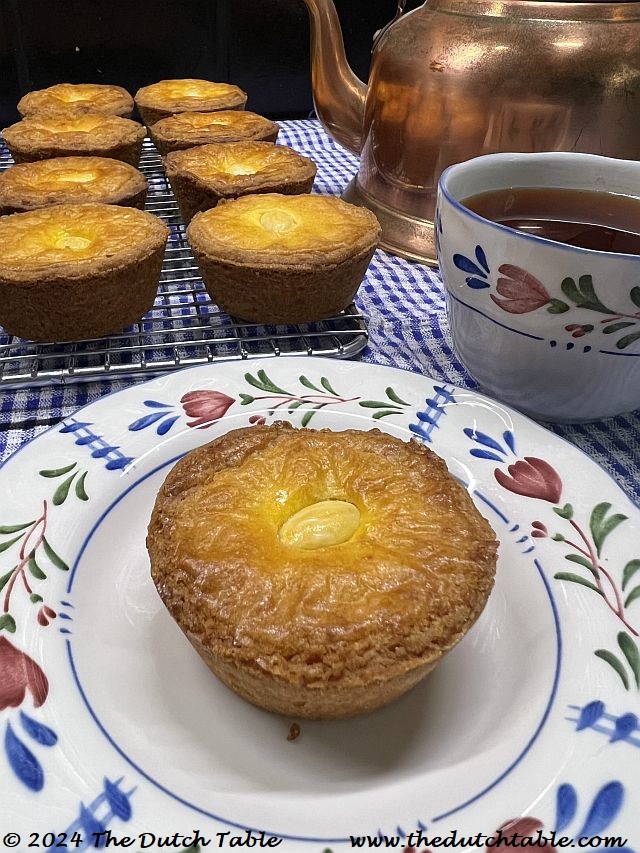
This recipe has been requested several times, and rightfully so. If you've been around Dutch baked goods, you know we have a love for anything almond paste filled: gevulde koeken, amandelbroodjes, kerststol, gevulde speculaas...you name it. Today's treat is no different: an individual koek (a large cookie) portion filled with sweet almond paste. They come in two shapes: round called rondo, and elongated, called kano, but they're both the same baked good. I don't have that much more information about them, oddly enough. They start appearing in bakery advertisements around the middle of last century with apparently no previous or historical reference. I will do some more digging! 

The kano and rondo require a dedicated ring or elongated bottomless baking form, which would be hard to come by for those of us abroad, but I made do with a muffin pan like this one, one that has 12 holes, each one about 3 inches (7.5 cm) wide and about 1 inch (2.5 inch) deep. It changes the shape a bit but not the flavor - yay! If you don't have any almond paste left over from our holiday baking, see if you can make the almond paste a day or two ahead of time. It is not mandatory, but will improve the flavor. However....don't let it keep you from making these. Any rondo is better than no rondo ;-)

This makes approximately 10 rondo's

Rondo's

For the dough
2 sticks (225 grams) butter
1 cup (150 grams) sugar
2 teaspoons baking powder
2 cups (300 grams) all purpose flour
1/4 teaspoon salt
Zest of 1/2 lemon
1 egg, beaten

Filling
1 cup (250 grams) almond paste
1/2 egg, beaten
1 teaspoon almond extract or flavoring

Topping
1/2 egg, beaten
10 plain, skinless almonds

Cut the butter in with the sugar, the baking powder, the flour, the salt and the lemon zest, until it resembles wet sand, then add the egg, and knead until the dough comes together. Wrap and chill. Mix the almond paste with half a beaten egg and a teaspoon of almond flavoring until it's well absorbed. Chill until use.

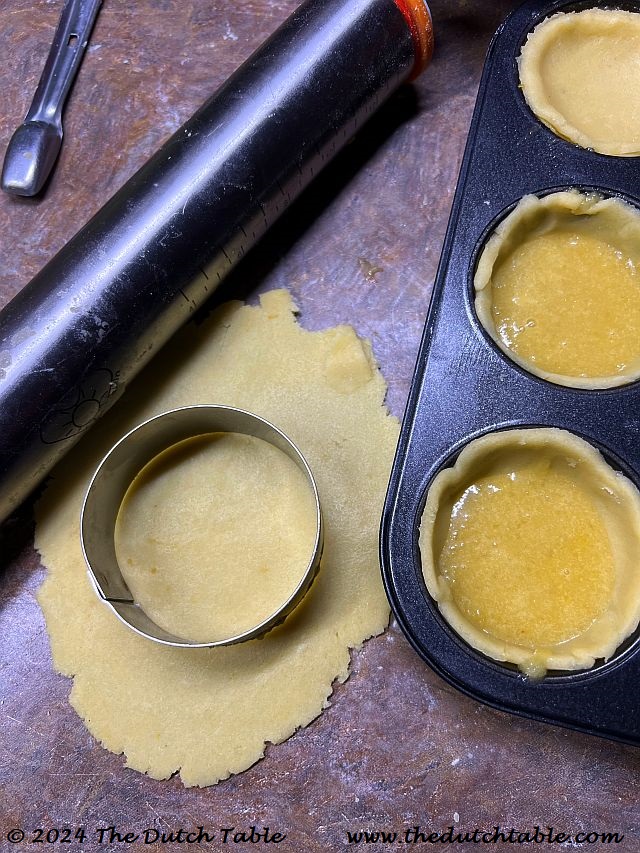
Remove the dough from the refrigerator, and roll out to 0.1 inch (3mm) thick. The diameter of the muffin cups is 3 inches, so you will need a cutter that measures 3.5 inches (8.8 cm) wide. I use an English muffin mold but a large jar lid will work as well. Spray each cup lightly and then carefully position a dough circle inside each cup, lining the sides almost to the top (see picture). 

Divide the almond paste between the rondos. Roll out the dough again and now cut out 10 circles, 3 inches wide, and place each circle on top of the almond paste. Carefully tap the sides of the circle with your finger so that it makes contact with the rest of the dough. Brush with the egg, and decorate with an almond piece. 

Bake in a 375F/190C oven for about 20 minutes or until golden brown. 


Bloemkool

I was reading through a stack of older housekeeping magazines looking for vegetable recipes, and I kept coming across cauliflower. We used to eat a lot of cauliflower! Not surprising really, because bloemkool has always been an affordable and available vegetable in the Netherlands. It's mostly grown around West-Friesland, in North Holland, on the islands and near Venlo in Limburg. 

Bloemkool is also a very versatile vegetable: it's easy and quick to prepare, and is fairly neutral in taste. Nowadays, bloemkool is eaten both raw (in salads or with a dip) and cooked, as a substitute for rice and mashed potatoes in low-carb recipes, or in au gratin casseroles, cheesy soups or as the main vegetable in the traditional Dutch AGV (potatoes, vegetables, and meat) menu. 

The other reason why cauliflower kept coming up so much is that it was so easy to use up if you had leftovers. The menu said to serve cauliflower boiled like today's recipe one day, and then make soup or an oven casserole out of the leftovers the next day. Nothing like Dutch frugality/practicality to create new dishes out of what was not used the previous day! I am quite appreciative of that creativity, to tell you the truth. 

Looking up to see how much we consume nowadays I thought it was interesting to read that, according to a Dutch magazine survey from 2021, people under 40 years old do not include cauliflower at all in their top 10 of vegetables, and those over 60 only as their 8th most purchased one. Surprising, because cauliflower is low-cal, has plenty of fiber and anti-oxidants and contains choline and sulforaphane, important for eh...all kinds of things. It's just not a very instagram-able vegetable, I guess? 

The cauliflower I prepared today is served oma-style, the old-fashioned way, which is boiled and with a "papje", a white sauce. Traditionally, this is accompanied by boiled potatoes, and a choice of meat, most often a gehaktbal, a meatball, but it goes well with almost any kind of protein. Colorwise, it's all very beige on your plate, I can't even make it look good in the picture, but it is such a comforting dish! Big, soft lumps of cauliflower, covered in a silky, creamy sauce seasoned with salt and pepper, and a sprinkling of nutmeg on top....you can't go wrong. IF you like cauliflower, that is. This is one of those dishes that you either love or hate - there is little in between! 

I prefer to make the sauce with the cooking liquid, and a splash of cream at the end, to get more of that cauliflower flavor, and any possible nutrients that may have survived the boil, so I keep an eye on the cooking time, and try to not overcook it. I save the rest of the cooking liquid to purée the leftovers with the next day and make a cheesy bloemkoolsoep for lunch, but if you don't care for leftovers or cauliflower soup, feel free to use milk only.

For this recipe I used fresh cauliflower, but frozen works just as well. 

Bloemkool met een papje

2 lbs (1 kg) cauliflower, rinsed and broken into florets
5 cups water
1 teaspoon salt

For the sauce
4 tablespoons (50 grams) butter
1/3 cup (50 grams) flour*
2 cups (500 ml) milk or cooking liquid
Salt, white pepper, nutmeg

Bring the water to a boil, salt, and add the cauliflower. Boil at medium heat for about fifteen minutes, then check to see if the texture is to your liking: the longer you cook it, the softer it gets. 

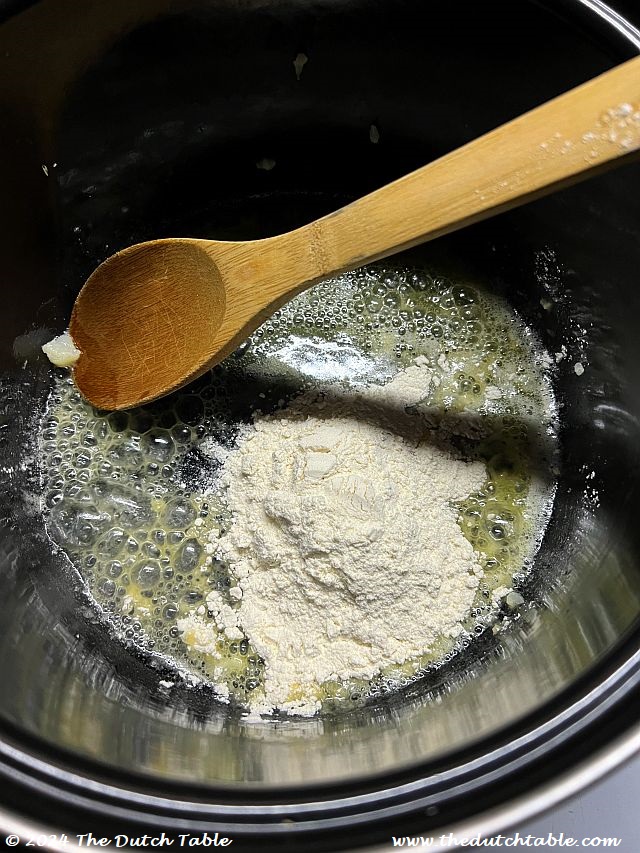
When it's the right texture, drain the cauliflower but save the water, and measure out two cups (500 ml). (Don't discard the rest of the cooking water if you are planning on making soup with the leftovers). Put the empty cooking pot back on the stove, and in it, melt the butter (do not brown). With a wooden spoon, stir in the flour until the two have come together as a paste, and slowly add the two cups of milk or cooking liquid, while stirring. Keep stirring until the lumps are gone and the sauce has thickened and is hot. Bring up to taste with salt and pepper. 

Add the cauliflower back into the pot with the sauce, stir once or twice so that the vegetable is covered with the sauce, or serve the sauce on the side. Right before serving, sprinkle a pinch of nutmeg over the cauliflower. Serve with boiled potatoes.   


*If you would rather not use flour, use cornstarch to make a slurry and bind the sauce.

Tomatenschoteltje

There is an abundance of "schoteltje" recipes in our traditional kitchen, like "broodschoteltje", "macaronischoteltje", "beschuitschoteltje", "rijstschoteltje". It appears to be a collective name for predominantly sweet dessert dishes, but not always, like today's savory dish. 

I don't really have a good translation for the "schoteltje" part. Schoteltje literally means "small dish". The recipes themselves fall somewhere between small casseroles, au gratin dishes, or cocottes - but they're not always a full-blown casserole, which would imply cooking for a lengthy time in the oven using raw ingredients (because that would be an "ovenschotel", an oven dish), and not all recipes require gratin, and sometimes cocottes are initially meant to contain personal servings, which also doesn't apply. So for now, I am going with the unsatisfactory English name of "dish". Maybe you can help me come up with something better? 

Most schoteltje recipes are generated straight out of our frugal tendencies: they use up old bread, leftover rice or pasta, even oliebollen, and often incorporate eggs, a food that is still affordable for most. So too this recipe, that uses up a glut of tomatoes, a handful of leftover shredded cheese, and a few eggs.

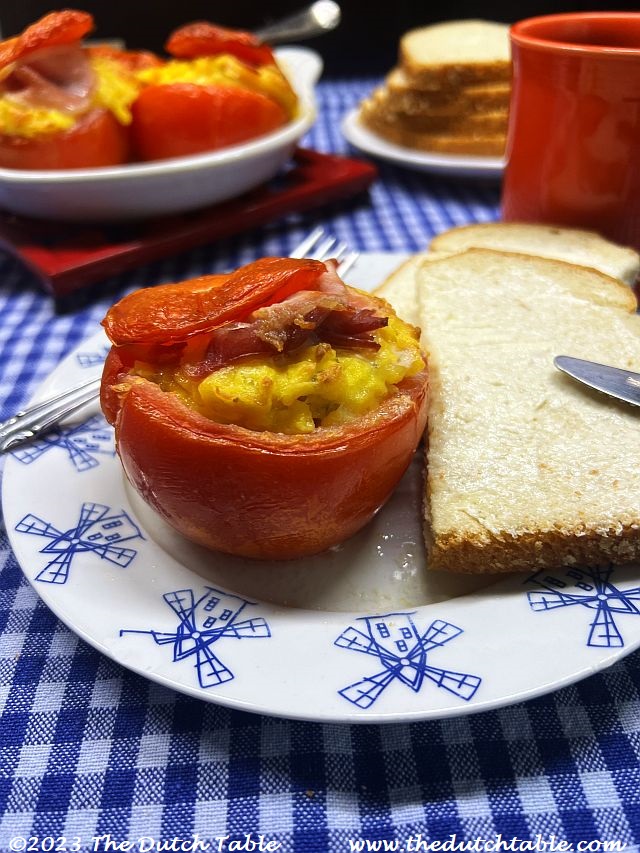
This recipe is a great lunch or brunch dish: tomatoes stuffed with cheesy scrambled egg, topped with bacon, and baked in the oven until the skin and flesh of the tomatoes softens and become jammy. Together with a green salad, or a few slices of bread or toast, it's a satisfying meal, and an affordable one. 

Tomatenschoteltje

4 large tomatoes
5 eggs
1 cup (100 grams) shredded cheese
4 strips bacon
Butter
Salt
Pepper
Herbs (optional)

Cut the top of the tomatoes, and put the caps aside for now. Hollow the tomatoes out with the help of a spoon. Save the seeds, or puree the tomato pulp and save it for soups. Sprinkle a little bit of salt on the inside of each tomato, and place it upside down in the dish. In the meantime, crack the eggs and whisk them, then melt the butter in a skillet. Add the egg mix, and when it starts to set, add the cheese, then scramble the eggs. Season with salt and pepper and herbs, if desired. Don't overcook the eggs.

Heat the oven to 400F/200C. Turn the tomatoes right side up, stuff them with the scrambled eggs, and top each one with a strip of bacon. Replace the cap, add a little bit of water to the bottom of the dish, and bake the tomatoes for 20 - 25 minutes, until the caps are slightly shriveled and the tomatoes are starting to burst. 

Serve warm, with toast, or a green salad. Eet smakelijk!


Why can't I print your recipes???

 Every now and then I get that question. It usually comes with a string of question marks or the occasional angry face. I’ve mentioned my reasons in passing before, but after receiving another heated message last week, I figured it was time to put everything in one place so you all know where I stand. I realize this might cost me a few readers, but I also think it’s important that you understand why...and maybe even feel inspired by it.

When I started The Dutch Table in 2009, my dream was to create a living repository of recipes, filled with the stories behind our dishes, our food traditions, and our history. I wanted a place to preserve the flavors and memories that shaped us, something to reach for when memory might one day fade. Many years later, I feel grateful that this vision has taken root. Thousands of people visit the website, try the recipes, read the stories, and sometimes share their own. Our community isn’t just Dutch readers; it’s children and grandchildren of Dutch immigrants, people married into Dutch families, and those who simply fell in love with our food somewhere along the way.

Not long after I started the site, the emails began to arrive: requests for help in finding recipes that existed only in memory: “My grandmother used to make something like this…” or “My dad talked about this dish, but I don’t remember the name…” Sometimes we’d start with just a single detail. Over the years, I’ve gathered a small library: cookbooks, housekeeping guides, gardening books, folklore,  preservation manuals, paired with countless hours of digging through newspapers, ads, journals, handwritten notes, anything that might hold a clue. The joy of rediscovering a dish that someone feared was lost forever has been worth every moment. Because it’s never just about food, is it? It’s about memory, identity, and the people we love. 

As a small business owner, my content is not only my livelihood but also a part of my personal creative expression. Having it freely printable makes it challenging to manage and protect my work. More importantly, I believe in the charm and tradition of handwritten recipes. There's something special about a recipe that's been copied down by hand, perhaps with personal notes and adaptations, and then passed on. It's a way of making each recipe your own and creating a legacy that can be handed down through generations.

A handwritten recipe becomes part of you. Your notes, your substitutions, the date scribbled in the corner, the oil stain from when you were rushing around the kitchen: it all turns into a tiny piece of family history. Those pages become treasured in a way that printed sheets rarely do.

To be clear: you can print the recipes. A simple right-click, “print,” choose your pages, and boom! -they’re yours. But I want to gently encourage you to try something different: take the time to copy down the recipes you love by hand. Perhaps in a notebook or scrapbook, or even on recipe cards. Add notes about when you served it, who loved it, what it reminded you of. Doodle in the margins. Let it get a little messy. Keep it close at hand in the kitchen. An online recipe is easy to find, but a handwritten one carries your memories, and that is what makes it priceless.

I hope this helps explain my perspective. And I hope you’ll continue cooking, reading, remembering, and keeping our culinary heritage alive: one recipe, and one story, at a time.

Thank you for keeping our culinary heritage and traditions alive, and for your support always.

Nicole

Notebooks

I put these blank notebooks (120 and 200 lined pages) together with some of my favorite vintage Dutch images. You can see the selection here, If you buy through this link, the Amazon Services LLC Associates Program will pay us a small commission on qualifying purchases. It does not increase your cost or price, and it will help us keep the website running. Your support is very much appreciated!