Jodenkoeken

The Dutch have a huge cookie culture. The shelves in the grocery store are loaded with sugary breads, cookies, tarts and every other product that can be eaten with a cup of coffee or tea. It is said that the Dutch will only offer you one cookie with your hot beverage, as they are so tight-fisted, but I have yet to experience that. Most hosts just leave the cookie jar on the table and invite you to help yourself.

A traditional Jodenkoeken cookie can.
Beside the coloring, flavors and shapes of the cookies, the most memorable are without a doubt their names: bokkepootjes (billygoat's legs), kletskop (bald head or chatterbox), Weesper moppen (blobs from Weesp), Arnhemse meisjes (girls from Arnhem), ijzerkoekjes (iron cookies), lange vingers (long fingers) or kattetongen (cat tongues). Another cookie with a huge following is the so-called "jodekoek" or Jewish cookies.

The story goes that Davelaar, a cookie baker, bought a bakery from a retiring Jewish baker in the early 1920. The bakery was famous for these large, sweet and buttery cookies and Davelaar continued to bake them, selling them in metal cookie cans and charging a deposit. During the seventies, the name of the cookie was considered not-politically-correct and Davelaar changed it for the export cookies, but never did for the national market. To this day it's called "Jodekoek" or Jewish cookie.

The size of the cookie is most remarkable, it measures a whopping 3.5 inches across. Not very impressive for an American cookie, but most certainly for a Dutch one. The ingredients are few but come together wonderfully as a sandy, buttery cookie: do make sure you use top quality ingredients.

Jodekoek
1 stick of butter, room temperature
1/4 cup of sugar
1 tablespoon milk
1/2 teaspoon cinnamon
pinch of salt
1 cup of self-rising flour, packed

Cream the butter and the sugar. Add the milk, the cinnamon and the sugar. Knead the flour into the mix, blending all the ingredients. Wrap in foil and refrigerate for an hour.

Preheat the oven to 350F.

Dust the counter with flour and roll the dough thin, about 1/4th of an inch or less. Cut out the cookies with the help of a canning ring for widemouth jars, it's the right size. Place the cookies on parchment paper on a sheet pan and bake for approximately 15 minutes until golden brown. The last few minutes you may want to keep an eye on the cookies as they "over-brown" rather quickly.

Enjoy with a cup of hot tea, coffee or hot chocolate.

Hete Bliksem

 In this quest to investigate, research and write about the culinary traditions of my country, I stumble across some very interesting details. For one, I think there is nary a thing a Dutch person wouldn't add to a dish of mashed potatoes: we have mashed potatoes with carrots (hutspot), mashed potatoes with kale (boerenkool), mashed potatoes with sauerkraut, a whole array of mashed potatoes with greens and today I am making mashed potatoes with apple.

Boerenkool
The potato was first introduced in the Netherlands in the early 1600's but was not officially recognized as fit for human consumption until 1727. Since then, the country has been producing a large variety of potatoes such as Eigenheimers, Bintjes, Alphas, Irenes, Gelderse muisjes. As with other agricultural products, Holland is one of the market leaders regarding the export on potatoes.

The traditional meal in Holland consists of the Dutch trinity: meat, vegetables and spuds. Most traditionally boiled, potatoes can also be served fried or mashed. One of my favorites are pan-fried potatoes: boil some extra potatoes the day before, chill them, then slice the next day and fry in some butter in a skillet until they are golden brown and crispy. Yum!

Hete Bliksem
Today's dish is called "hete bliksem" or hot lightning. Not entirely sure what generated the name. Some say it's because the high amount of liquid in the mash: the dish stays hot longer than other types of mashed potatoes. That is true, there is no additional milk needed to mash these potatoes and apples into a smooth consistency and it does stay warm longer. Other names for this savory and sweet potato dish are "heaven and earth" referring to the source of apples (heaven) and potatoes (earth), or "thunder and lightning".

The key is to use a mixture of sweet and tart apples, 2 parts potato, 1 part apple. Jonagolds, Braeburns and Jonathans will do well by themselves as they possess both flavors.

Hete Bliksem
8 large potatoes
4 apples (2 sweet, 2 tart)
4 slices of salted pork

Peel and cube the potatoes and place them in a pan with just enough water to cover them. Peel and core the apples, cut in halves and place on top of the potatoes, top with the slices of salt pork. Cover and bring to a boil, then simmer for twenty minutes or until potatoes are done. Remove the pork, pour off the water (save some) and mash the apples and potatoes to your liking, lumpy or smooth. If it's too dry, add a tablespoon at a time of the cooking liquid. Taste. Adjust with salt and pepper if needed.

Slice the pork in narrow strips, mix in with the mashed potatoes and serve. Good with a lick of mustard.


Pasteitje met ragout

As Calvinistic as we are, bent on not having too much of anything and claiming that "being normal is crazy enough", we are set on extending the Christmas celebrations over two days instead of one. First Christmas Day is December 25th, Second Christmas Day is December 26th. And if you are part of those families that also celebrate Christmas Eve, that makes it two days and a half.

Christmas Eve is traditionally the night where you dress up, go to evening mass (even those that are not raised in the church will often attend) and upon return to the house round off the celebrations with hot chocolate and, how else, a bread meal with luxury rolls.

First Christmas Day is a formal dinner day and a day that is generally celebrated with family only. If you are invited to someone's home on First Christmas Day, and you are not family or in any way related, it is quite an honor! This is also the day that will determine where you stand, family-wise. In trying to keep the peace between families and in-laws, children often switch back and forth between families on 1st and 2nd Christmas Day: one year you will celebrate dinner at your parent's on the 1st, the next year it's at your significant other's parents. Being invited, or visited, on 2nd Christmas Day almost automatically classifies you as 2nd class family member......

Second Christmas Day is much less formal. It's when the leftovers are eaten, and everybody runs around in their "house suit", sweats and jammies, hanging in front of the TV or going for long, wintery walks to get some fresh air. Friends will sometimes come over for a drink and a chat, and a less formal dinner (not leftovers!!).

So many of these traditions are slowly changing but one of the standard items on Christmas Day is this appetizer or starter for the meal: a puff pastry cup filled with a chicken and mushroom gravy. It is so seventies, but it is one of those dishes that is comforting, filling and familiar at the same time.

I had some chicken leftover from last night's dinner club. It's getting close to Christmas and all of a sudden I had a hankering for a pasteitje met ragout.......You can also use leftover chicken from your Sunday roast. 

Pasteitjes, puff pastry shells, can be found in the store, in the freezer section. If you can't find them, make your own shells out of a sheet of puff pastry, or serve the ragout with rice or on bread.  

Pasteitje met ragout
For the pasteitjes:
2 sheets of puff pastry
1 tablespoon of flour
1 egg, beaten

Dust the counter with flour and thaw the sheets. Cut eight circles out of the pastry dough. Out of four of these circles, press a smaller circle from the middle. Wet the full circles with a little bit of water, place the rings on top and brush the whole pastry with egg. Place the cut outs on the side, poke them a couple of times with a fork so they don't puff up too much, and brush as well.

Bake on a sheetpan in a 425F oven for ten to twelve minutes or until golden and puffy. Cool on a wire rack.

Ragout
1 tablespoon of butter
2 chicken breast
1 large onion, peeled and sliced
3 garlic cloves, peeled and minced
1 small can of mushrooms (or one cup of fresh mushrooms, sliced)
2 1/2 cups (500 ml) white wine
2 1/2 cup (500 ml) warm water
1 chicken bouillon cube
2 bay leaves
Sprinkle of thyme

For the gravy
1/3 (50 grams) cup flour
4 tablespoons (50 grams) butter

If you have time, marinate the chicken breast the night before in a bowl with the wine, water, onions, bay leaves, thyme and crushed garlic cloves. 

Heat the olive oil in a Dutch oven, add the sliced onion and the garlic cloves and sauté until translucent. Add in the mushrooms and continue to sauté for another two to three minutes, or until the mushrooms have a bit of a sear on them. Dry the chicken, cut it into large cubes, season it with salt and pepper and quickly sear it on all sides in the same pan. Add the wine, the warm water, and the bouillon cube and bring to a boil. Turn down the heat, add the bay leaves, a sprinkle of thyme and pepper and simmer for at least 25 minutes, covered.

Take the chicken out of the stock. The meat should be tender enough that you can pull it apart with two forks. If not, return to the pan and simmer longer. Using a large sieve, separate the meat, mushrooms and onion from the liquid. 

In a different pan, melt the butter, stir in the flour and quickly make a paste. Add a ladle full of your cooking liquid to the sauce and stir until it's absorbed. Do the same with four more ladles, until you have a nice pan full of gravy. Now add the cooked meat, the mushrooms and the onion to the gravy. Taste and adjust the flavor with salt and pepper if needed.

Carefully place the pasteitjes on a plate, fill with ragout, sprinkle with some parsley if you want and serve!


Honingkoek

Breakfast is always a treat in Holland. The amount of cold cuts is amazing, the cheese is fabulous and the large variety of breads always makes it difficult to choose from. If you're not in the mood for bread, you can pick a Dutch rusk, beschuit, a cracker or a large slice of Dutch "breakfast cake" or ontbijtkoek.

Ontbijtkoek is a cake-like quick bread, soft, sweet and with a variety of spices and flavors. The enticing mix of cinnamon, ground cloves and nutmeg is the basis for a large variety of different breads: ontbijtkoek is also known as peperkoek if it also contains a snuff of white pepper, honingkoek if it has an additional amount of honey, gemberkoek if the cake is studded with candied ginger or kandijkoek when the top of the cake is covered in sugary pearls.

Not all ontbijtkoeken are solely consumed for breakfast.  The koek can be sliced and eaten by itself, dry, or improved with a dab of real butter as a snack, or with a cup of coffee. Children will often get a slice to hold them over until dinner, and a popular game at birthdays and national celebrations is "koekhappen", cake nipping. Thick slices of ontbijtkoek are individually suspended on a larger rope, so that they dangle right above the heads of the, sometimes blindfolded, children. Adults on either side of the rope will lower the koek until right above the children's heads who, in order to get a bite out of the cake, have to jump up and nip at the delicacy. First one to finish the koek is declared the winner! The Dutch company Peijnenburg, famous for its koeken, uses koekhappen in most of their commercials: this one is still my favorite!

This morning I was in the mood for honingkoek. It's an easy cake to bake, it fills the house with lovely smells and it's a perfect afternoon snack for later. If you have all the ingredients, this cake can be on your breakfast table in the time it takes you to get the newspaper, make a pot of coffee and toast the bread.

This recipe is for an 8 x 4 inch loaf pan: double the recipe and you'll be able to bake two (save one in the freezer for later!), or bake a larger koek in a 9 x 5 loaf pan. If you do, stick to one egg, and increase your baking time to 50 minutes.

Honingkoek
2 cups self-rising flour (300gr) or two cups regular flour and 2 tsp baking powder)
1/2 cup (75 grams) brown sugar 
1 tsp cinnamon
1/4 tsp ground aniseed (optional)
1/4 tsp ground cloves
1/4 tsp ground nutmeg
Pinch of salt
1/2 cup of honey (75 gr)
1 cup of milk (120 ml)
1 egg

Grease an 8 x 4 cake pan. Preheat oven to 350F. Add all the dry ingredients to a bowl and mix together. Set the mixer on low and add the wet ingredients, one at a time. Scrape the sides of the bowl once or twice. Mix until you have a smooth batter, approx. 2 minutes. Pour the batter into the pan, bake for 30 minutes or until a toothpick comes out clean. Let the ontbijtkoek cool on a wire rack, then slice and serve with butter. Best saved in a plastic bag at room temperature, will keep for several days.


Erwtensoep


This morning, when I looked out the window, there was snow on the mountains, and the temperature had dropped significantly overnight. Seeing the snow and smelling the crisp air all of a sudden made me crave erwtensoep, a comforting Dutch split pea soup. It's no wonder that this soup is served when people take their New Year's dip in the North Sea each January 1st - it is a stick-to-your-ribs kind of soup, hearty, comforting and provides plenty of fuel.

Split pea soup can also be found for sale in "koek-en-zopie" shacks on, or next to, the frozen canals and lakes. These shacks sell hot soup, mulled wine, coffee and cookies - a great way to warm up after a fun day on the ice!

Snert, another name for erwtensoep, will often be quoted as THE Dutch soup. As of February 2019, it has even been added to the list of Dutch intangible cultural heritages! But as popular as it may be, pea soup has been around much longer than we have, and many cultures have a version of soup made with peas. In our case, the soup features smoked pork meat and tends to be thick - in fact, so thick that a wooden spoon can stand up straight without falling over!

The soup can be served for lunch as the main dish, or as a starter. It is often served with dark rye bread and bacon on the side, or in this case, with plain pancakes. For a more exotic twist, people will sometimes serve erwtensoep over rice, with a lick of sambal or sriracha sauce and fried onions on top. If you're not in the mood for pancakes, and don't feel like rye bread, try the rice sometime!

This basic recipe is ready in less than an hour. The pork can come in a variety of ways: bacon, kielbasa, smokies, smoked neck bones.....You can choose only one, or combine two, but flavorwise, it's best to have at least one smoked meat product in there. I personally like a smoked rope sausage and two pork chops. Makes enough for four generous servings.

Erwtensoep

2 cups split peas (450 grams)
7 to 8 cups water (1.6 to 1.8 liters)
2 medium carrots, peeled
2 ribs celery (or one cup diced celery root)
1 small onion, peeled
2 bay leaves
Black pepper, optional
Pinch of salt, optional
About 12 little smokies, and/or a smoked rope sausage, rookworst, thick bacon, or pork chops.

Rinse the split peas and remove anything that doesn't belong (stones, sticks, dried up discolored peas...). Put the peas and water in a stock pot. Chop the vegetables and add to the peas. Bring to a boil, add the bay leaves, then turn down the heat and simmer for about 40 minutes. Make sure the soup does not burn so give it a stir every now and then - and add some water if you feel the soup is getting too thick.

If you use raw meats, add the meat in at the beginning. If you are using smoked pork chops, or neck bones, simmer them with the soup for the last twenty minutes, then remove and shred the meat. Add the meat back to the soup.

When the peas are soft, remove the bay leaf and either puree the soup with a stick blender or just stir the soup several times vigorously. The peas will dissolve and give it a creamy consistence. Stir in the little smoked sausages or the kielbasa (slice before adding), and heat the soup back up until the meat is hot. Taste the soup, and adjust the salt level if needed. Add a dash of black pepper, if you like.

This is an easy, quick solution for when you come home and want a filling, comforting soup. I always keep a pack of little smoked sausages or a kielbasa in the fridge just for that. Split peas do not have to be soaked in order to cook quickly so you can have this soup on the table in less than an hour.

Pancakes
1 1/2 cup (225 grams) flour
1 1/2 cup milk (350 ml)
2 eggs
Pinch of salt
2 tablespoons butter (± 30 grams), melted but not hot
Butter to fry

Mix the flour, milk, eggs into a batter and add the salt, and the two tablespoons of butter. Cover and rest for thirty minutes. Heat a frying pan, on medium temperature. Melt one tablespoon of butter and add 1/2 cup of batter.  Flip the pancake when the bottom is golden and fry the other side. Makes six to 8 pancakes. Store under tea towel or pan lid to keep soft. They can be served plain with the soup, or slathered with jam for dessert. 


Boerencake met appel en kaneel

 I don't know why we tend to add the prefix "boeren" (farmers) to food items that are larger than usual. Boerensoepgroenten (yes, that is a word!), or farmers soup vegetables, are the same vegetables as the traditional soepgroenten that consist of carrots, leeks and celeriac, but cut in larger chunks. The same with "boerencake": it's like any other cake, just larger. Odd. Maybe it's because the Dutch farmers work hard and need to eat more food?

On Sunday, my dear friend Naomi brought over a bucket full of apples to process. I ate some, baked with several others and am dehydrating the rest. Since the weather looks just like a typical Dutch fall weather (cold, rainy, dark) and I have not much else to do but watch the apples dry, I decided to bake a golden boerencake with some apples and cinnamon to bring a little bit of light into the kitchen. It worked!

It is important that your ingredients are at room temperature as it will improve the texture of the cake.

Boerencake

2 sticks minus 1 Tablespoon (200g) butter
1 cup (200g) sugar
4 eggs
pinch of salt (if butter is unsalted)
1 teaspoon vanilla extract
1 1/2 cup (200g) all-purpose flour
1 heaping teaspoon (6 grams) baking powder
1/2 teaspoon cinnamon
2 small-ish apples(approx. 0.5 lb/250 grams), or 1 big one
1 Tablespoon coarse sugar

Cream the butter and the sugar until they've formed a cohesive, fluffy mass. Break two eggs, and add them one by one, until absorbed into the batter. In a separate bowl, set one tablespoon of the flour aside, and mix the rest of the flour with the baking powder and the cinnamon. Add half of the flour mix to the batter, fold it in, then add the remaining two eggs, one at a time, and the rest of the flour and mix until you have a lovely, thick batter.

Peel and core the two apples. Dice 1 apple, dice half of the other, and slice the remaining half into thin slices. Toss the diced apple with the tablespoon of flour and fold it into the batter. Grease and flour a 9 x 5 (+/- 22 cm) cake form, and spoon the cake batter into the form. Stick the sliced apples in the top, about halfway down into the batter, in a pleasing pattern (I like a herringbone pattern). Sprinkle the tablespoon of course sugar over the top, and bake the cake on the middle rack in an 350F (175C) oven, for about 45 minutes or until golden, and a toothpick comes out clean. Cool before slicing.


Boerenkool met worst

It looks like it froze for the first time last night. Bad news for the garden's summer vegetables, but this is the time that other veggies benefit from cold nights, like kale. The Dutch have a very solid and varied repertoire of winter dishes: solid in the sense that they mainly consist of the culinary trinity (meat, vegetables and potatoes) and varied because well....because there is scarcely a vegetable the Dutch don't add to their famous "stamppot".

Literally meaning "stomped pot", stamppot is a dish that consists of boiled potatoes mashed with a raw or cooked vegetable. The meat is either served on top, on the side, or cut into small pieces and mixed in. If the choice of protein generates any type of pan juice or jus, it will be served in a small hollow made on top of the mashed potato dish, the so-called "kuiltje jus" (similar to a pothole in the road, but different).

Those who know me well, will be surprised to see that I served up mashed potatoes with kale, a dish simply called "boerenkool", so named after the vegetable, farmer's cabbage or kale. There are few things in the food world that I don't care for, and one of them is boerenkool. As a child, I avoided it as much as I could (we were raised to eat what was on our plate) and as a grown-up it never once made it to the menu. 

Somehow the American kale is not as bitter as the Dutch one is (or perhaps my taste buds have adjusted), so after preparing this dish with Michiel for Idaho's Melting Pot, I was pleasantly surprised, enough even to go home and cook it for myself two days later. It's been a keeper ever since.

Kale is a dark-leaf vegetable that will add plenty of nutrition to your diet: it is riddled with vitamins and minerals and contributes plenty of protein. The butter and the kielbasa....not so much. But if you are looking for a healthier option, skip the butter and the milk, save the cooking liquid of the potatoes and vegetables instead. As you mash the vegetables, add a tablespoon of the warm liquid at a time until you reach the desired consistency.

Kale with kielbasa

1 lb ( approx. 500 grams) kale
2 lbs (1 kg) floury potatoes (Russetts will do well)
3 tablespoons (45 grams) butter
1/2 cup (125 ml) milk, warmed
1 smoked rope sausage like kielbasa, or Polish smoked sausage
Salt
Black pepper

Cut the leaves off the stems and slice the leaves into narrow strips, then chop them into small pieces. Peel the potatoes, quarter them and place them in a Dutch oven. Add water to barely cover the potatoes, and salt the water. Bring the potatoes to a boil. After fifteen minutes, add the raw kale, and place the kielbasa on top. The amount of kale will look enormous compared to the potatoes, but the heat will wilt the leaves and reduce in volume significantly. 

Cover the pot with a lid and bring back to a boil. Boil on low/medium heat for about 10 more minutes or until the potatoes are done. 

Remove the sausage, pour off any cooking liquid that may remain and mash the vegetables with a fork or a potato masher. Add the butter and the milk (or for a less caloric version, add a little bit of the cooking liquid back in) and stir the whole into a creamy consistency. Taste, and adjust with salt and black pepper.

Slice the kielbasa into even sized slices, and place it on top of the stamppot. Serve with mustard if desired.


Arretje's cake

During the early years, before and after the war, companies in Holland realized that one way of reaching into the tightly pinched pockets of the Dutch housewife was through the hearts (or the constant jengelen) of her children. Marketing companies invented mascots, fictitious people and fantasy figures to distinguish their company from other ones, and promoted their products in marketing materials such as booklets, cartoons, radio ads and even short movies. Especially the cartoons were very popular among the younger kids, and if you happened to own some, you could be assured of plenty of attention!

Flipje is sharing Betuwe goodies
with his friends.
Image from
www.levensmiddelenkrant.nl/
Piet Pelle was a fictitious young man who rolled into one exciting adventure after the other on his Gazelle bicycle. Flipje from the Betuwe, a fertile fruit growing region in the Netherlands, was something akin of a young man, with a human head, the body of a raspberry and limbs made out of currants. His head was adorned with a chef's hat and he would always end his adventures with a party, inviting everybody to eat copious amounts of jam, fruit juice and other fruit related products that, oh coincidence, all came from the Betuwe region. Joris Driepinter, Joe ThreePints, was the figure for the dairy industry, showing that by drinking three glasses of milk a day, you would have enough strength to even lift up a car. Okay.

Arretje Nof was another one of those concoctions of the marketing agencies. The Nederlandse Olie Fabriek (Dutch Oil Factory, or NOF) published regularly booklets about the adventures of a young Arab boy called Arretje-NOF. The cartoons could be purchased by saving coupons with points that were printed on the packaging of NOF products. Not many remember the cartoons but the one thing that, to this day, appears prominently in traditional Dutch desserts is the so-called Arretje's Cake.

The NOF board butchered a beautiful Italian recipe for chocolate salami, stripped it from all quality ingredients and replaced it with affordable items that were easy to find for the Dutch cook: margarine (which the NOF happened to produce in large quantities), dry cookies, sugar and cocoa powder instead of butter, luxury cookies and quality chocolate. Nevertheless, the Arretje's cake (presumably named because that's what Arretje celebrated his birthday with) became a huge success in Holland and has become one of those indelible memories of treats that grandmas make for, or with, their grandchildren.

Is it tasty? Most say that they love this no-bake cake. You can hardly go wrong with sugar, cookies, chocolate and butter. Try for yourself and see what you think! The original recipe calls for shortening, but margarine or even butter ("real butter" as the Dutch say) is more commonly used.

Our recipe includes raw eggs, but brings the batter up to 140F (60C) on the stove to make sure any pathogens are destroyed. Raw or undercooked eggs can be a safety risk. If you don't have a food thermometer, or want to be on the safe side, please use vanilla pudding or heavy cream as an alternative. Safety first!

Arretje's Cake
2 sticks butter (250 grm)
1 cup sugar (225 grm)
6 tablespoons cacao powder (40 grm)
2 eggs (or 1/4 cup of vanilla pudding or heavy cream)
2 oz dark chocolate
About 60 dry Maria cookies*

Melt the butter slowly in a sauce pan, until just melted, on low to medium heat. Mix the sugar and cacao in a separate bowl and set aside.

Beat the eggs well. Temper the eggs with some of the butter (pour in a little bit of the warm butter and stir into the eggs until it's incorporated) and keep adding the butter to the eggs until they're both mixed. Pour the mixture back into the sauce pan and take it back to the stove. Stir in the cocoa and sugar and keep stirring until they're blended into a thick chocolate sauce. Make sure all the sugar has dissolved. If you rub a little bit of the mixture between your thumb and index finger and it feels gritty, the sugar has not yet dissolved.

Grate the dark chocolate, or break it into small pieces and add it to the sauce pan. Keep stirring, and bring the temperature of the mixture up to 140F (60C) and keep it there, while stirring, for 3 1/2 minutes. If you are using vanilla pudding or heavy cream, you can skip this step. Just warm it up enough to melt the chocolate.
Take the sauce pan from the stove and let it cool a bit. In the meantime, add the cookies to a bag, or fold them into a clean towel, and roll your rolling pin over the cookies several times. You are looking to break the cookies into pieces no larger than a quarter.

Fold the cookies into the chocolate paste until they're all well covered. Line a cake pan with parchment paper or plastic film, spoon the mixture into the pan and flatten it with a spatula, making sure there are no air bubbles.

Cover and refrigerate for at least four hours, or overnight. Lift the cake out of the pan, and cut into thin slices. This cake is very rich!


* If you don't have Maria cookies, consider any other crisp cookie: iced oatmeal cookies, Oreos, or even Animal Crackers will work!

Bitterballen

In Holland, a night out on the town, or a social event with coworkers, usually starts out at a local café, with a beer and something called a "bittergarnituur". The word translates as the slightly confusing "garnish for bitters", where bitters in this case refers to alcoholic beverages. The Dutch were one of the first to dedicate themselves to perfecting the distillation process, presenting the world with spirits such as Dutch gin (jenever) and a large variety of liqueurs and bitters, these last ones presumably with medicinal properties. Nowadays, one of the most famous drinks is Ketel One, a Dutch vodka that is especially popular in the United States.

Alcohol is traditionally consumed with something savory on the side, and thus the bittergarnituur was invented. This colorful platter will usually contain bite-size cubes of Gouda cheese, miniature eggrolls and meatballs, perhaps some slices of salami or chorizo and of course, how can it not, the marvelous bitterballen.

Bitterballen are one of Holland's favorite snacks. In the early and mid-1900s, they were the housewife's perfect way to transform yesterday's meat leftovers into today's appetizer. Served shaped as a log (kroket) or in bite-size rounds, bitterballen were often served as an aperitif, or tapa, before lunch or dinner.

Nowadays, bitterballen are predominantly served outside the home, either as part of the bittergarnituur or as a snack on the side with a portion of French fries, but are no longer part of the housewife's culinary repertoire. Which is rather unfortunate, because bitterballen are easy to make and freeze beautifully for later use! 

This deep-fried, crispy, bite-size ball of meaty gravy is to be eaten with a good, savory mustard. Take the bitterbal between thumb and index finger, dip one side into the mustard and pop the whole thing in your mouth. No double-dipping! Bitterballen are also, presumably, best eaten while piping hot!

Bitterballen are traditionally made with beef, but can also be made with chicken, veal or even with mushrooms, for those that prefer a vegetarian option.

Bitterballen
1 stick butter (114 gr)
1 cup all purpose flour (120 gr)
3 cups beef stock (700 ml)
3 tablespoons onion, minced
1 tablespoon fresh parsley, minced
8 oz shredded and chopped cooked beef (250 gr)
Salt
Pepper
Nutmeg

For the breading
1/2 cup flour ( 60 grams)
2 eggs, beaten
2 cups bread crumbs (approx. 250 grams, depending on crumbs)

Make a roux with the butter and the flour (slowly melt the butter in a skillet or pan. When melted, add the flour little by little and stir into a thick paste). Slowly stir in the stock, making sure the roux absorbs the liquid and there are no lumps. Simmer for a couple of minutes on a low heat while you stir in the onion, parsley and the shredded, chopped beef. Bring it back up to heat while stirring.Taste, add pepper and salt and a pinch of nutmeg. Taste again and adjust if necessary.

Pour the meat gravy into a shallow container, cover and refrigerate for several hours, or until the gravy has solidified.

The mixture should be so thick that you can cut squares out of it. Take a heaping tablespoon of the cold, thick gravy and quickly roll it into a small ball. I weigh mine out at approx. 20 grams each, or .7 ounces. They can be a bit bigger, up to 23 grams, as long as they're all about the same.

Roll lightly through the flour, and put them back in the fridge while you prepare the next round of covering. Beat the eggs well. If you use panko, you may want to pulse them once or twice in the kitchen processor, or just squeeze it between your fingers, as some pieces tend to be fairly large.

Take the floured balls out of the fridge and rub them between your palms once more, if they need rounding a bit more, then carefully dip them in the egg on the tines of a fork. Make sure that the egg covers the whole surface of the bitterbal. (If it doesn't, the filling will spill out into the fryer and you will be left with a hollow shell, and a messy fryer!). Tap the fork on the rim of the plate to remove any extra egg, and then roll the ball through the bread crumbs. Set each ball aside on a plate.

*Optional: after breading them once, I personally prefer to pop them in the freezer for about half an hour, and then I egg and breadcrumb them again. This creates a slightly larger bitterbal, but with a thicker crust. 

If your kitchen is exceptionally warm, you could refrigerate them in batches of ten. But when all are done, refrigerate or freeze the snacks while the oil in your fryer heats up to 375F. If you are not planning on serving all 50 bitterballen, you can freeze them individually and then store them in a closed container in the freezer for later. There is no need to thaw them before frying.

Fry five to six balls at a time, until golden brown. Serve on a plate with a nice grainy or spicy mustard.


Makes approximately 50 bitterballen.


Macaroni

Ten percent of the Dutch population thinks that macaroni and chili con carne are.......Dutch dishes. I kid you not. Eighty-seven percent of that same population eats macaroni at least once a week. When you ask children here in the USA what their favorite kind of food is, they'll usually say: Pizza! Dutch kids would tell you that macaroni was their favorite food.

A Dutch TV show called "Man Bijt Hond" ("Man bites dog") has a section called "Hond Aan Tafel", where the camara crew knocks on a random house door around dinner time and asks the surprised habitants if they can join them. Most often the answer is yes, and the short scene allows for a peek in the life of just an ordinary person. Nine out of then, the answer to "What's for dinner?" is...you guessed it.....macaroni.

And they're not the only ones that love macaroni. Yours truly enjoys a huge plate of the salty, warm, comforting pasta with a pickle on the side to provide some crunch, yummmmm!!!!!!!!!!!! It's one of the many reasons why I keep ground beef in the freezer: once the meat is thawed, this dish is quick and easy to prepare. Just what you need when you're looking for some comfort!

Dutch Macaroni
3 cups of elbow macaroni or fusilli
1 lb of ground beef
1/2 a leek, white only, sliced thin
1 red pepper
1 sachet of macaroni spices*
1 small can of tomato sauce
Pickles, optional

Cook the macaroni according to instructions. Brown the ground beef in a skillet, pour off the fat and add in strips of red pepper and the sliced leek. Stir in the spices and the tomato sauce, simmer for ten minutes. Add the macaroni and mix with the sauce. Serve warm.


* I buy the macaroni spices in Dutch stores online, but the spaghetti spice mix packages that are available in your standard supermarket are practically the same.

Mosselen

Zeeland, the most Western province in the Netherlands, is famous for its mussels, specifically the towns of Bruinisse, Tholen, Yrseke, and Zierikzee. The fishing town of Yerseke in Zeeland is the mussel epicenter of northwest Europe; approximately 90 million kilos of mussels a year come from Yrseke alone. The majority of the mussels go straight to buyers in Belgium, where mussels and fries are considered a staple dish, but in the Netherlands we are also known to enjoy a big pot of mussels, especially when spending a day on the coast.
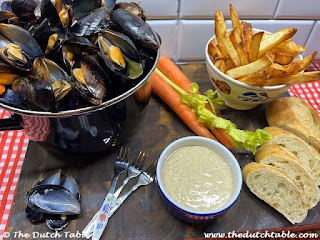
Traditionally, mussels were on the menu when the letter "R" was present in the name of the month, i.e. starting in September, but nowadays they're available as soon as July.  As soon as they're ready for harvesting, advertisements pop up everywhere, and from September until about April you can find these bivalve mollusks on the menu at restaurants, for sale at the fishmongers, and on many a dinner table all over the country. And it sounds odd, but once I see the advertisements, I start craving them. It's one of those typical "gezellig" things to do: get a big pot of steamed mussels on the table, gather some good friends, a bit of wine, a salad, a crispy baguette, a couple of dipping sauces, and get the party started! 

Fresh mussels are not available to all of us, but nowadays it's quite easy to get good quality frozen ones, so look for them in your grocery stores. About a pound per person is enough for dinner, if you serve it with a salad, fries, and bread, otherwise you may consider a pound and a half, two if they're big eaters. I serve mine with a traditional mustard dipping sauce, but you are welcome to bring your own: curry-flavored dipping sauces and herby ones like a yogurt-parsley sauce also go really well. 

Don't eat the ones that don't open up during the cooking process: they're likely to be bad. Also, watch out for broken shell pieces. 

Mussels
4 pounds (approx. 2 kg) fresh or frozen mussels, in shell
1 cup (250 ml) white wine
1 small onion, peeled and sliced
1/2 carrot, peeled and diced
1 rib celery, diced
2 cloves garlic, peeled and minced
2 bay leaves
5 black peppercorns

Dipping sauce
2 tablespoons mustard
2 tablespoons mayonnaise 
1/2 tablespoon vinegar

Mix into a smooth sauce.

Give the mussels a quick rinse (no need to thaw), and check for "beards": little hairy-looking extensions protruding from the shell. Carefully pull those off, if you find them. 

Put the rest of the ingredients in a Dutch oven, or another big pan with a heavy bottom and a lid. Bring to a boil. Lift the lid, add the mussels and boil for seven to eight minutes, tossing the contents of the pan every now and then. The mussels will open up and will be ready to eat.

To serve, place the pan on the table with an extra plate for the shells. Serve with fries, a green salad, and a dipping sauce. Use your fingers to pull the mussels out of the shells or a small fork, and dip into the sauce. 

Smaokelik! (as they say in Zeeland!)


Bruine Bonen met Rijst

Brown beans and rice, or as we say in Holland, bruine bonen met rijst, is a typical dish from Suriname, a former colony of the Netherlands. Here in America, I don't have easy access to the Dutch brown beans, so I use pinto beans instead.

Bruine Bonen met Rijst
1 small piece salt pork
1 small onion, peeled and diced
1 garlic clove, minced
1 tomato, deseeded and chopped
2 cans pinto beans, drained and rinsed
1 cup water
1/4 cup tomato sauce
1 teaspoon ginger
1 teaspoonblack pepper
1/2 beef bouillon cube
1 bay leaf
1/4 cup celery leaves
1 tablespoon sugar
1 cup instant rice
Water

Cut the salt pork in small dice, then fry in a skillet until soft and transparent. Add the onion and the garlic. Stir until soft, then add the tomato. When the tomato has softened as well, add the beans, the water, the tomato sauce, ginger, pepper, the bouillon cube and bay leaf. Bring to a boil, then lower the heat and simmer for about twenty minutes. Taste and adjust (don't add any salt before tasting, the pork tends to be salty enough), add the sugar and the celery leaves, remove the bay leaf and stir everything together. Simmer for another five minutes while you prepare the rice.

Put the rice in a microwaveable bowl, add enough water so that the rice is covered, then microwave on high for two and a half minutes. Let it sit to dry for a minute or two, then stir.

Serve the beans on top of the rice. Nice with some crunchy slices of cucumber.


Hutspot met klapstuk

Yesterday, the city of Leiden celebrated the victory in 1574 over the Spanish invaders. It's an annual celebration during which the Leideners consume large amounts of white bread with herring and even larger amounts of something called hutspot, a colorful mashed potato dish. It's not only eaten on the 3rd of October, but is an extremely popular evening meal during the cold winter days. Hutspot is traditionally served with klapstuk, a piece of braised beef, but sometimes will also be eaten with a typical Dutch meatball. The best carrots to use for this dish are winterpenen, winter carrots such as the Flakkee or Autumn King, a larger and thicker variety of the orange carrot that is harvested shortly after the first frost. The sugars in the carrot add a hint of sweetness to this dish that will appeal to almost any eater, young or old.

The origin of this particular choice of starchy food goes back to a small remainder of stew that was presumably left behind in a large copper pot by the fleeing Spanish army. A young man found the still warm stew and shared it triumphantly with the rest of the starving Leiden-ers. Or at least with those that didn't like herring, I'm sure.

The name of this dish does not sound very appetizing, not even in Dutch. Loosely translated it means "hotchpotch with slap piece". Well, there you go, see what I mean? Who wants to eat that?

But, as is often the case, appearance deceives. In this particular example, the name is not very flattering and quite honestly, neither is the picture. But the taste will convince anyone that there is more to this dish than a silly name.

It is said that the original stew contained parsnips and white beans, and that the meat in the stew was mutton. How it came to be carrots with potatoes and beef.....only history knows. The carrot appeared in Holland for the first time in the 17th century, out of Iran, and was cross-pollinated until it had a bright orange color, to honor the royal family, the Oranges. At that point, the carrot was introduced to the rest of Europe and hey presto! Long live the Queen, and orange carrots for all!

As for the "slap piece": klapstuk is the meat that is cut from the rib. I used slices of beef chuck rib roast and it worked beautifully. The meat is marbled and during its 90 minute braising time will release all kinds of wonderful flavors and most of the fat. You'll love it!

Hutspot met klapstuk
For the meat
1 lb (500 grams) sliced beef chuck rib roast
2 cups (500 ml) water
1/2 beef bouillon cube
1 bay leaf
8 black pepper corns, whole
1 Tablespoon flour, dissolved in 1/2 cup (125 ml) water

Add the water to a Dutch oven or a braising pan, add the bouillon cube and stir until dissolved. Add the beef, the bay leaf and the pepper corns and braise on low heat for approximately 90 minutes or until beef is tender.

Remove the meat to a serving dish, discard the bay leaf and peppercorns and stir the dissolved flour into the pan juices. Stir scraping the bottom of the pan, loosening any meat particles that may be stuck. Bring the heat slowly up until the gravy starts to thicken. Pour the gravy over the meat and set aside, keeping it warm.

For the hutspot
6 large potatoes, peeled and quartered
8 large carrots, peeled and diced
4 large onions, peeled and sliced
2 cups (500 ml) of water
Pinch of salt

Place the peeled and quartered potatoes on the bottom of a Dutch oven. Pour in the water so the potatoes are just covered. Add the pinch of salt. Put the carrots on top, and finish with the onions. Cover and bring to a boil, then lower the heat and boil for about 20 minutes or until the potatoes are cooked. Pour off the cooking water, but save it. Mash the potatoes, carrots and onions until you achieve a mashed potato consistency or leave larger lumps, that's a personal preference. If you need more liquid to make it smoother, add a tablespoon of cooking liquid at a time, or for a richer taste, use warm milk instead. Taste, and adjust with salt and pepper if needed.


Now place a large scoop of hutspot on a warm plate. With the rounded side of a spoon, make an indentation on top of the hutspot, like a pothole. This is the famous "kuiltje". Put a slice of beef on top and pour a tablespoon or two of gravy into the kuiltje, and serve your beautiful, Dutch dish. 

Appelbollen

Those of you that read my other blogs know that, these last several years, I've been picking fruit in local orchards around the valley for most of my cooking and canning. For one, the price you pay for fruits when you pick them is at least fifty to 70% cheaper than in the store. The fruit is also fresh off the tree so it still has all its vitamins and minerals and, on top of that, you support your local farmers. A win-win for all, and it's a fun day out for the family. 
 
Early summer is cherry time, mid summer is peach and plum time, and now that the weather is cooling down a bit, the last of the apples and pears are coming off the tree. Oh joy!! Apples play an important role in the Dutch kitchen: appelmoes, apple sauce, is a standard condiment for many potato-based dishes (ever tried French fries with mayo and apple sauce? Don't knock it before you try it, it's the way Dutch children eat their fries) and a key ingredient in potato salad, Hete Bliksem (mashed apples and potatoes) and of course in desserts: Dutch apple pie, apple beignets and the old-fashioned Dutch apple dumpling, the appelbol. Sweet, firm apples in a puff pastry cover and filled with soaked raisins and walnuts.....What a delight! You want a firm apple for this dessert: I used a Golden Delicious, but a Jonagold, Gala or a Braeburn will do just as well. And if you don't have apples? Use a pear!

Probably not a coincidence that these dishes do best in a wintery, cold setting. The appelbol is more often than not a sugary treat with morning coffee, a sweet ending to a long, windy walk along the beach or together with a cup of hot chocolate after ice skating on the canals. Appelbollen are usually served warm and without any additional adornments such as whipped cream, but the last several years people have been adding warm custard or a scoop of vanilla ice cream. It's all good!

Appelbollen
4 medium sized apples
4 tablespoons (approx. 40-50 grams) golden raisins and currants, mixed
1 tablespoon (approx. 6-10 grams) walnut pieces, chopped
1/4 teaspoon cinnamon
3 tablespoons (approx. 35 grams) sugar, divided 
4 tablespoons (60 ml) apple juice or rum*
4 puff pastry squares (approx. 5 x 5 in/12 cm x 12 cm)
2 egg yolks
1 tablespoon water

Preheat the oven to 400F/200C. Wash the apples, and peel and core them. Mix the raisins, walnuts, cinnamon with 1 tablespoon sugar, and add the apple juice or rum. Set aside and soak for a couple of minutes, then fill each apple with the mixture. If you have boerenjongens, this is a good time to use them! 


Set each apple, top side down, on a square piece of puff pastry and wrap the apple, by pulling up each corner and tucking it slightly into the cored hole. Make sure all sides are covered and clinging to the apple. 

If you have some extra dough left and a couple of cinnamon sticks, you can make stems and leaves, but it's not necessary. If you do use cinnamon sticks, make sure to wrap the top with a little aluminum foil during the bake, as they tend to burn easily.

Make an egg wash with the yolks and the water, and brush on the dough. Sprinkle all four apples with the remaining sugar. Place each apple in a ramekin or small aluminum pie dish, smooth side up. Bake golden brown in 20-25 minutes.


*If you don't care for rum, try an apple-flavored schnapps or a cinnamon, hazelnut, or walnut flavored liqueur. 

Oranjekoek

Originally a Frisian wedding delicacy, this treat studded with candied orange peel and spices is a delight to the tastebuds. Nobody quite knows where and how it originated, and why it's called Oranjekoek if the frosting is pink, but who knows.. (oranje means "orange" as in the color, not the fruit.)

The House of Orange-Nassau, the aristocratic dynasty from which our royal family stems, lent the colorful addition to our country's current three colored flag: red, white and blue, with a separate vane in bright orange to show loyalty to the royal family. During international sporting events, you can recognize the Dutch supporters by their orange outfits, wigs and other sports-related items.

But back to the Oranjekoek. The original version is a single layer cookie/cake, frosted with a pink glaze. The dough contains orange peel and whole or ground aniseed (you can also use gestampte muisjes) and nutmeg and is, combined with the sweetness of the glaze, a great addition to your morning coffee or afternoon tea. More recent versions of the cake contain two layers, separated by a filling of almond paste and a swirl of whipped cream on top. I usually bake the single layer pink cake, but in order to celebrate the occasion of Koningsdag on April 27th, I baked the almond paste filled koek, used an orange glaze and added a dollop of whipped cream and some fresh fruit and candied orange peel, for looks.

The koek is originally served in squares and because of its cookie texture is easily picked up by hand and eaten as a cookie, rather than a cake. It will keep great in lunch boxes or cookie jars (without the whipped cream). Because of the cake's slightly dry nature*, it goes well with a glass of milk or a cup of coffee or tea.

Oranjekoek
1 1/2 cup (225 grams) all-purpose flour
1/2 cup (100 grams) sugar
1 tsp nutmeg
2 tsp aniseed (ground or whole)
1/4 cup candied orange peel and/or zest from one medium orange
5 tablespoons (75 grams) butter, cold and cubed
1 medium egg
Ice cold water

For the filling: (best made the day before)
1 cup (250 grams) almond paste
1 egg
1 teaspoon almond extract

For the glaze:
1 cup (125 gram) powdered sugar
1 tablespoon water
Red food coloring for pink, and red and yellow for orange.

For the topping:
1/2 cup (125 ml) whipping cream
1 heaping soup spoon powdered sugar
Fresh berries
Candied orange peel (optional)

Mix the flour and sugar together, then add the butter in small chunks. Keep mixing while you add the nutmeg, aniseed and orange zest, then add the egg. Add a tablespoon at a time of ice cold water to knead into a slightly sticky dough. Fold in the chopped orange peel (optional). Wrap the dough and let it rest in the fridge for about an hour. In the meantime, grind the almonds and the sugar together and fold in a beaten egg. For extra almond taste, add a drop or two of almond extract.

Heat the oven to 350F/175C. Grease an 8 x 8 inch (20 x 20 cm) square baking pan or baking sheet, or line with parchment paper, and divide the dough in two. Pat one part of the dough into the baking pan (allow for about an inch height). Spread the almond paste over the top and pat the second half of the dough on top.

Bake for approximately 25 to 30 minutes or until the cake is done: it will be quite lightly colored. Let it rest in the pan for about five minutes, then turn out and cool upside down on a rack.

When the cake is completely cooled, cover the flat top side with a glaze made of powdered sugar, the food coloring and a little water or milk. If you would rather use natural coloring, try blueberry juice for pink, or carrot juice for orange. Let the glaze dry for at least an hour. Cut into 9 squares, pipe some whipped cream on top and decorate with candied orange peel and fresh berries. You can wear an orange hat if you want to :-)

* sometimes I sprinkle orange liquor over the bottom of the cake (not the one that is going to be glazed) to make it a little moister.


Amazon Prime Shopping Suggestions: 

Disclaimer: if you buy through any of the links in the Amazon Prime Shopping Suggestions section, the Amazon Services LLC Associates Program will pay us a small commission on qualifying purchases. It does not increase your cost or price, and it will help us keep the website running. Your support is very much appreciated! 

Don't have Amazon Prime but want to give it a try? This link offers a 30 day trial.