Tomatenschoteltje

There is an abundance of "schoteltje" recipes in our traditional kitchen, like "broodschoteltje", "macaronischoteltje", "beschuitschoteltje", "rijstschoteltje". It appears to be a collective name for predominantly sweet dessert dishes, but not always, like today's savory dish. 

I don't really have a good translation for the "schoteltje" part. Schoteltje literally means "small dish". The recipes themselves fall somewhere between small casseroles, au gratin dishes, or cocottes - but they're not always a full-blown casserole, which would imply cooking for a lengthy time in the oven using raw ingredients (because that would be an "ovenschotel", an oven dish), and not all recipes require gratin, and sometimes cocottes are initially meant to contain personal servings, which also doesn't apply. So for now, I am going with the unsatisfactory English name of "dish". Maybe you can help me come up with something better? 

Most schoteltje recipes are generated straight out of our frugal tendencies: they use up old bread, leftover rice or pasta, even oliebollen, and often incorporate eggs, a food that is still affordable for most. So too this recipe, that uses up a glut of tomatoes, a handful of leftover shredded cheese, and a few eggs.

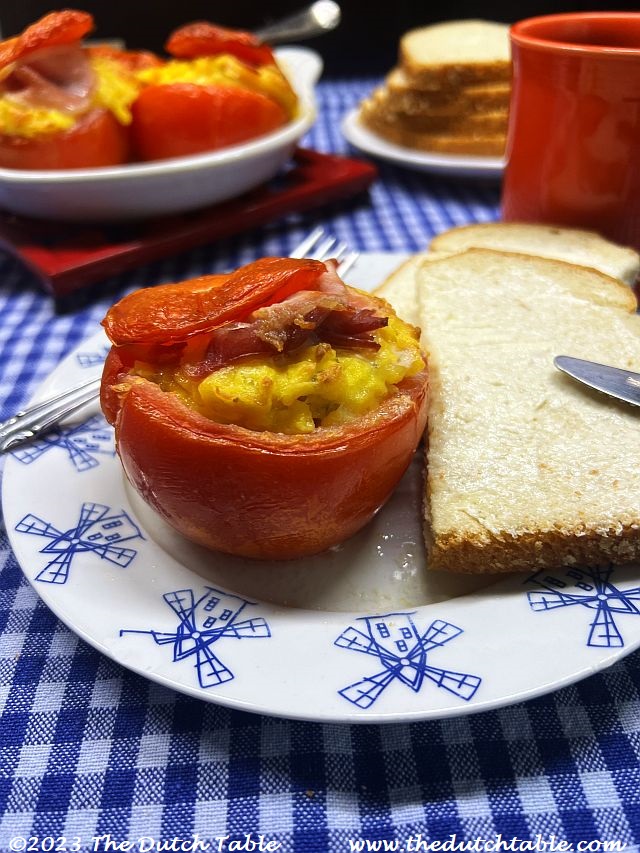
This recipe is a great lunch or brunch dish: tomatoes stuffed with cheesy scrambled egg, topped with bacon, and baked in the oven until the skin and flesh of the tomatoes softens and become jammy. Together with a green salad, or a few slices of bread or toast, it's a satisfying meal, as well as an affordable one. 

Tomatenschoteltje

4 large tomatoes
5 eggs
1 cup (100 grams) shredded cheese
4 strips bacon
Butter
Salt
Pepper
Herbs (optional)

Cut the top of the tomatoes, and put the caps aside for now. Hollow the tomatoes out with the help of a spoon. Save the seeds, or puree the tomato pulp and save it for soups. Sprinkle a little bit of salt on the inside of each tomato, and place it upside down in the dish. In the meantime, crack the eggs and whisk them, then melt the butter in a skillet. Add the egg mix, and when it starts to set, add the cheese, then scramble the eggs. Season with salt and pepper and herbs, if desired. Don't overcook the eggs.

Heat the oven to 400F/200C. Turn the tomatoes right side up, stuff them with the scrambled eggs, and top each one with a strip of bacon. Replace the cap, add a little bit of water to the bottom of the dish, and bake the tomatoes for 20 - 25 minutes, until the caps are slightly shriveled and the tomatoes are starting to burst. 

Serve warm, with toast, or a green salad. Eet smakelijk!


Why can't I print your recipes???

 Every now and then I get that question. It usually comes with a string of question marks or the occasional angry face. I’ve mentioned my reasons in passing before, but after receiving another heated message last week, I figured it was time to put everything in one place so you all know where I stand. I realize this might cost me a few readers, but I also think it’s important that you understand why...and maybe even feel inspired by it.

When I started The Dutch Table in 2009, my dream was to create a living repository of recipes, filled with the stories behind our dishes, our food traditions, and our history. I wanted a place to preserve the flavors and memories that shaped us, something to reach for when memory might one day fade. Many years later, I feel grateful that this vision has taken root. Thousands of people visit the website, try the recipes, read the stories, and sometimes share their own. Our community isn’t just Dutch readers; it’s children and grandchildren of Dutch immigrants, people married into Dutch families, and those who simply fell in love with our food somewhere along the way.

Not long after I started the site, the emails began to arrive: requests for help in finding recipes that existed only in memory: “My grandmother used to make something like this…” or “My dad talked about this dish, but I don’t remember the name…” Sometimes we’d start with just a single detail. Over the years, I’ve gathered a small library: cookbooks, housekeeping guides, gardening books, folklore,  preservation manuals, paired with countless hours of digging through newspapers, ads, journals, handwritten notes, anything that might hold a clue. The joy of rediscovering a dish that someone feared was lost forever has been worth every moment. Because it’s never just about food, is it? It’s about memory, identity, and the people we love. 

As a small business owner, my content is not only my livelihood but also a part of my personal creative expression. Having it freely printable makes it challenging to manage and protect my work. More importantly, I believe in the charm and tradition of handwritten recipes. There's something special about a recipe that's been copied down by hand, perhaps with personal notes and adaptations, and then passed on. It's a way of making each recipe your own and creating a legacy that can be handed down through generations.

A handwritten recipe becomes part of you. Your notes, your substitutions, the date scribbled in the corner, the oil stain from when you were rushing around the kitchen: it all turns into a tiny piece of family history. Those pages become treasured in a way that printed sheets rarely do.

To be clear: you can print the recipes. A simple right-click, “print,” choose your pages, and boom! -they’re yours. But I want to gently encourage you to try something different: take the time to copy down the recipes you love by hand. Perhaps in a notebook or scrapbook, or even on recipe cards. Add notes about when you served it, who loved it, what it reminded you of. Doodle in the margins. Let it get a little messy. Keep it close at hand in the kitchen. An online recipe is easy to find, but a handwritten one carries your memories, and that is what makes it priceless.

I hope this helps explain my perspective. And I hope you’ll continue cooking, reading, remembering, and keeping our culinary heritage alive: one recipe, and one story, at a time.

Thank you for keeping our culinary heritage and traditions alive, and for your support always.

Nicole

Notebooks

I put these blank notebooks (120 and 200 lined pages) together with some of my favorite vintage Dutch images. You can see the selection here, If you buy through this link, the Amazon Services LLC Associates Program will pay us a small commission on qualifying purchases. It does not increase your cost or price, and it will help us keep the website running. Your support is very much appreciated!

Bitterkoekjes

Almonds have a prominent place as an item of luxury in the baked goods of the Netherlands. One of our oldest cookery books, Een notabel boecxken van cokeryen (A Remarkable Book on Cooking) published around 1514 by Thomas van der Noot in Brussels, already contains several almond based recipes. Christmas stollen are enriched by having a ribbon of almond paste running through its middle, speculaas is enhanced by adding a layer of almond paste inbetween, and numerous cookies and pastries contain almonds in various ways. 

So too today's cookie, the bitterkoekje, bitter cookie, so named after the bitter almonds that were traditionally used in its recipe. In a different book, this one from 1832, it said that "cookies made from bitter almonds" were shared at weddings to symbolize the ups (sweet) and the downs (bitter) of marriage. What a pity that this custom is no longer practiced! 

Bitterkoekjes are crispy on the outside and slightly chewy in the middle, and are made with the basic ingredients of ground almonds, powdered sugar, and egg white. The bitter flavor comes from pure almond extract. so check your extract to make sure it lists "bitter almond oil" in the ingredients.  Because they don't contain any flour, these cookies are also a good gluten-free option. If you choose almond flour instead of grinding your own, read the ingredients list to make sure there are no other additives.

Bitterkoekjes
1 cup (150 grams) powdered sugar, packed
1 1/2 cup (150 grams) finely ground almonds 
Pinch of salt
1 teaspoon pure almond extract
2 eggs, egg whites only, divided

Line your baking sheet with a double layer of parchment paper. Heat the oven to 375F/190C. Sift the powdered sugar. Mix the almond with the powdered sugar, the salt, the almond extract, and one egg white until it's well mixed. Add a little bit at a time of the second egg white until you have a consistency that can be piped but is not too liquid that it will spread on its own - look at the picture to the right for an example of consistency. 

Pipe marble sized dollops onto the baking sheet (or use a tiny ice cream scoop, or two small spoons) leaving a little bit of space between. Bake for 10 - 15 minutes, but check the color after 10 minutes. Because of the high sugar content, these tend to go from light golden to dark brown in no time, so keep checking! Makes approx. 60 small cookies.

Cool on the paper on a rack, and when they're cooled, peel them off the paper. Keep in a tin. As time passes they will get hard if you're in a dry climate - a slice of bread in the tin will help soften. 


Amazon Prime Shopping Suggestions: 

Disclaimer: if you buy through any of the links in the Amazon Prime Shopping Suggestions section, the Amazon Services LLC Associates Program will pay us a small commission on qualifying purchases. It does not increase your cost or price, and it will help us keep the website running. Your support is very much appreciated! 

Don't have Amazon Prime but want to give it a try? This link offers a 30 day trial.