Setting Your Shoe: A Tasty Sinterklaas Tradition

Girl with clog filled with hay and a carrot singing in front of a fireplace
In the Netherlands, the magic of Sinterklaas begins long before the big night of December 5th. For many families, the excitement truly kicks off in mid-November, right after Sinterklaas arrives by steamboat from Spain. From that moment on, children may set out their shoe (“schoen zetten”) once or twice a week, usually on Saturday evenings or whenever the family decides it’s time for a little extra sparkle in the darkening days of fall.

Traditionally, the shoe is placed near the fireplace, the symbolic entry point for Sinterklaas’s helpers, the Pieten. These days, with most homes relying on central heating, the hearth may simply be a radiator, a hallway corner, or even the foot of the stairs. Children don’t mind, magic works anywhere! 

Shoe setting is far from a new tradition. Historical documents have shown that, starting in 1427, shoes were placed in the Nicolai Church in Utrecht on December 5th, the evening of St. Nicholas' Day. Wealthy Utrecht residents put money in the shoes, and the proceeds were distributed among the poor on December 6th, the official day of the death of Saint Nicholas. From the 16th century, we see descriptions of children placing shoes in the living room...and the tradition continues to this day. In the Netherlands we still place shoes. In the United States and Canada, the shoe has made place for a stocking. 

What Goes Into the Shoe

Before bedtime, children carefully select a shoe and fill it with small offerings for Sinterklaas’s horse, Ozosnel (or Amerigo, depending on the tradition). A carrot, apple, or even a handful of hay is tucked inside, often accompanied by a drawing or a hopeful note. Some kids add a bit of water in a cup "just in case the horse gets thirsty,” showing the earnest logic (though never questioning how Piet will make it through the central heating!) that makes this tradition so endearing.

Once the shoe is set, the children gather around to sing Sinterklaas songs, their voices rising with pure excitement. Whether it’s in front of an actual fireplace or a perfectly ordinary radiator, the ritual is the same: singing, hoping, and imagining.

The Morning Magic (and Parental Panic)

By the next morning, the offering has mysteriously disappeared, replaced by a small treat. Sometimes it's a mandarin orange, a tiny toy, a handful of kruidnoten, strooigoed, or the much-desired chocolate letter. But every Dutch household knows the other side of the story too: the parents’ occasional jolt of panic upon waking: The shoe! We forgot the shoe! that leads to whispered scrambling in the early hours, hoping the children haven't woken up yet, and a stealthy dash to fill the shoes to prevent disappointment. 

If the children discovered that Piet did not stop by the house that night before you were up, often a handwritten apology letter from Piet or Sint (it's good practice to keep one handy for those unfortunate moments!) or faking a text message saying that the weather kept Sint from coming over last night will help. 

Shoe-Setting Beyond the Home

The tradition doesn’t stop at the front door. Throughout the Netherlands, shops, supermarkets, garden centers, and even banks join in the fun. Merchants set out rows of paper shoes, ready for young visitors to decorate and leave behind for Sinterklaas. A week later, children return to find their paper shoes filled with tiny surprises.

A Tradition That Never Fades

Whether you're setting a shoe by the fire, the heater, or a cardboard display of a chimney at the local store, the ritual of schoen zetten captures everything people love about Sinterklaas: anticipation, generosity, laughter, a bit of mystery, and a whole lot of warmth.

It’s one of those Dutch traditions that lingers in memory long after childhood, because in those small moments of belief and excitement, the month of December becomes truly magical. We would love to encourage you to bring that magic into your own home, whether with your children, grandchildren, or any little ones in your life. Traditions connect us. They anchor our kids in where we come from, and they create warm memories that last forever. 

What You Can Do

Let’s revive the joy of setting a shoe! Not just for gifts for our (grand)children, but as a way to teach them that generosity is the real magic of Sinterklaas. Imagine a home, a school, or a store filled with little shoes meant not for the taker, but for the giver. Here are some ideas:

Shoes for Sharing: Children set their shoes with coins, small toys, or non-perishable items inside, not for themselves, but to be collected and donated to a local food pantry, shelter, or charity.

Paper Shoe Campaigns: Stores or malls can give children a blank paper shoe to decorate. Inside, children can “fill” it with messages, coins, or small gifts. The store collects these and donates the proceeds or items to a local charity.

Local Charity Tie-In: Partner with senior centers or hospitals: children decorate paper shoes with drawings or notes, which are then delivered to residents, brightening their day. 

Let us know in the comments if and how you shared this tradition! 

Mandarijnentoetje

For as far back as I can remember, oma had a package of maïzena, cornstarch, on her kitchen shelves. It was a bright yellow cardboard box, with one or two red spoons across the front, hiding out towards the back of the cupboard. I am pretty sure that box was the one and only one she ever bought, and it just resided in the cupboard for "just in case", as I don't ever remember her doing anything with it: she used to thicken her sauces and soups with flour, the traditional way. 

Nevertheless, cornstarch has a long history in the Dutch kitchen. Its arrival in the Netherlands dates back to the 19th century, around the same time that cornstarch became popular in other parts of Europe. The brand name Maizena was introduced in the United States in 1862 by the Duryea brothers, and less than a year later the product was already available on the Dutch market, and winning medals at the London and Hamburg expositions. What I found curious is that cornstarch was not only recommended as the "non plus ultra of all fine dishes" as the advertisement below indicates, but that cornstarch was also an "unsurpassable food for the weak and those with stomach ailments". How it was used for this category of sufferers I was not able to determine from my readings, but my guess is that it would make porridges that were easy on the stomach, and would potentially reduce any effects of gluten intolerance? If you know, let me know!

Nowadays in Dutch cuisine, maïzena is primarily used to thicken sauces, soups, and gravies, as not many have the knowledge (and the patience) to use flour instead. It can also be used in baking, often as a part of the mixture for cakes or pastries, contributing to a tender crumb, like in slagroomtaart, our typical birthday cake, and is essential in making several traditional desserts, such as vla (a creamy Dutch custard) or today's dessert, mandarijnenpudding.


Advertisement from Opregte Haarlemsche Courant

2 January1864

A big reason for its popularity is because of how quickly something comes together, like today's mandarijnenpudding. This is a safeguard against unexpected and last-minute guests, and you probably have all the necessary ingredients at hand. If you don't like mandarin oranges, you can use canned peaches or pears instead, or fresh raspberries or strawberries. If you prefer Nilla cookies over ladyfingers, use those - these desserts are easy to make your own and create new family favorites! Makes six medium, or four large servings.

Mandarijnenpudding

1 11 oz (315 grams) mandarin oranges, in light syrup
2 cups (475 ml) milk
1/2 cup (60 grams) cornstarch
3/4 cup (120 grams) sugar
Zest from 1 fresh mandarin orange, divided
12 ladyfingers

1 cup whipping cream
1 heaping Tablespoon powdered sugar

Drain the can of mandarin oranges, but keep the juice. Keep 6 pretty mandarin slices aside, and coarsely chop the rest. Add enough milk to the juice to make it to 3 cups (750 ml), then use a few tablespoons of the mixture to make a paste out of the cornstarch. In a heavy-bottomed saucepan, pour in the rest of the milk, juice and the sugar. Bring the milk up to a low simmer, and stir the cornstarch paste into the pan. Keep stirring until the paste dissolves and the liquid thickens, about five minutes. Take off the stove, and fold the chopped mandarin slices in. Put it back on the stove, and stir until it's incorporated, then remove off the heat. Stir in half of the mandarin zest, then set the pan aside to cool. 

In the meantime, break up 6 of the ladyfingers into small, bitesize pieces and divide them over 6 glasses. When the pudding is cooled down enough (about 20 minutes) divide over six glasses or cups. Cover with plastic film to avoid skin forming, and put the glasses in the fridge until you are ready to use. 

Right before serving, whip the cream with the powdered sugar. Pipe the whipping cream, or use a spoon to make a big dollop on top, and decorate with a slice of mandarin orange, a ladyfinger, and the remaining zest. Serve cold. 


Stamppot

Stamppot is the ultimate Dutch comfort food—a hearty, rustic dish that has been a staple of Dutch kitchens for centuries. The name stamppot literally means "mashed pot," and it perfectly describes the process of mashing vegetables together with potatoes to create a warm, filling meal. It also uses affordable, easily accessible ingredients - how Dutch is that! It’s a one-pot dish, simple yet deeply satisfying, especially on cold days.

Stamppot isn’t just food; it’s part of our Dutch heritage, it's in our genes. As soon as the cold weather hits, the cravings for stamppot explode. It evokes memories of cozy family dinners and the comforting flavors of home. It’s a dish that connects generations and reflects the down-to-earth, practical nature of Dutch cuisine. 

It’s a dish we’re often teased about, as though our only contribution to global cuisine is a humble plate of mashed potatoes with vegetables. But if you’ve been following this website for a while, you know that’s far from the truth—Dutch cuisine has had more influence than we often care to boast about.

That said, a steaming plate of stamppot may not be earning Michelin stars anytime soon… but it will win the hearts of everyone you serve it to. I have yet to meet anyone who’s turned up their nose at our beloved stamppots!

The mashed vegetables are often root vegetables (carrots, onions) or greens (kale, cabbage, endive) and stamppot is traditionally served with smoked sausage (rookworst), bacon or crispy bacon bits, meatballs and gravy, and even a fried egg on top! But it doesn't have to be meat: crispy tofu, fish sticks, dried fruit, or a handful of cashew nuts are often used as substitutes for meat. While stamppot made with potatoes is a beloved classic, modern variations often include creative ingredients like sweet potatoes, roasted garlic, or even vegan options with plant-based sausages.

The most common varieties of stamppot, with a link to the recipes, are:

  • Boerenkool Stamppot: made with kale and potatoes, often regarded as the most traditional version, and still the favorite of all stamppots.
  • Hutspot: a mix of potatoes, carrots, and onions—legend has it this dish dates back to the Siege of Leiden in 1574!
  • Andijviestamppot: raw endive is mixed in for a slightly bitter and fresh flavor.
  • Zuurkool stamppot: sauerkraut adds a tangy twist to the dish. (This is a keto version with cauliflower)
  • Rodekoolstamppot: stewed red cabbage with apples are mashed into hot, fluffy potatoes.
  • Spruitjesstamppot: Brussels sprouts for a slightly bitter flavor. Together with appelmoes, apple sauce, it's a great way to start kids on the more challenging vegetables.
  • Hete Bliksem: the apples in the dish hold their heat so the dish is called "hot lightning". 

And we wouldn't want to miss out on that kuiltje, a little well in our stamppot to hold the pan gravy, to make sure that every bite is extra flavorful! 


Rode Kool Stamppot

Red cabbage, that wonderful red-almost-purple vegetable bowling ball, belongs (together with white cabbage, Savoy cabbage, and pointed head cabbage) to a variety called "sluitkool", or head cabbages. Head cabbage is a general collective name for those cabbages whose leaves are so densely packed that they more or less form a 'head'. Other types like bladkool, leaf cabbage, would be kale, boerenkool, farmer's cabbage.

In the Netherlands, cultivation traditionally takes place in North Holland. This reflects back in the names of vintage or heirloom varieties: Langedijker Allervroegtste, Langedijker Herfst, and Langedijker Bewaar. This is also where 60% of the Dutch red cabbage acreage is located, but cultivation also takes place in South Holland, Limburg, and North Brabant. 

The variety of cabbages in the Netherlands is high, and one can find several types sold at greengrocers or vegetable stores at the same time. The top ten most popular cabbage varieties are: 

  • Witte kool (white/green cabbage)
  • Rode kool (red cabbage)
  • Boerenkool (farmer's cabbage = kale)
  • Spruitjes (Brussels sprouts)
  • Bloemkool (cauliflower)
  • Savooiekool (Savoy cabbage)
  • Spitskool (pointed head cabbage)
  • Chinese kool (Chinese cabbage, Napa cabbage)
  • Paksoi
  • Broccoli

Of the head cabbages, the two types that are most easily found are the white (often called green) and the red. Both can be used raw by shredding it for salads, fermented as in zuurkool (sauerkraut) or kimchi, and in a variety of hot dishes. White/green cabbage is very flavorful as creamed cabbage, and red is great stewed with apples or pears, and a little splash of vinegar to maintain the color. 

Cabbages are also great for making a stamppot, that ultimate Dutch comfort food: mashed potatoes (or cauliflower if you're going low-carb) and vegetables. The combination of slightly salty, fluffy potatoes and the various flavors that the vegetables contribute, make each stamppot delicious. Is it pretty food? No, but it's at the heart of many as our typical, traditional winter food, like a warm embrace. 

Rodekoolstamppot pairs well with beef stews, rabbit, or pork, like slavinken. Don't feel like cooking the cabbage? There are several commercial varieties of red cabbage with apple out there which will make this dish even quicker to prepare! 

Rodekoolstamppot

2 lbs red cabbage
1 small apple
4 bay leaves
3 whole cloves
2 tablespoons red wine vinegar or apple cider vinegar
1 cinnamon stick
1 tablespoon brown sugar
1 tablespoon cornstarch

2 lbs potatoes
2 tablespoons butter

Peel the outer, tough leaves off the cabbage. Cut the cabbage in half, then each half in half again. This will give you an easy opportunity to cut out the core which is tough and bitter. Slice each quarter into thin strips. Rinse the cabbage and add to a pan with a heavy bottom. 

Add enough water to cover the cabbage about halfway, and set it on the stove. Add the bay leaves and cinnamon stick, cover and bring to a slow boil. Stir in the vinegar, add the sugar, stir and cover again. Turn down the heat to a simmer. Let it slowly braise on the back of the stove, for a good half hour.

In the meantime, peel, core and quarter your apple. Stick the three cloves in the largest piece of apple before adding them to the pan, and slowly simmer until the apple is soft. Remove the cabbage and apple from the pan until you only have the braising liquid left. Fish out the bay leaves and the cinnamon stick, and pick the cloves off the apple. 

Make a slurry with the cornstarch (one tablespoon of water to one tablespoon cornstarch). Bring the cooking liquid back up to a boil, and stir in the slurry. At first it will color the liquid pink but as the cornstarch absorbs the water, it will clear up. Continue to stir until the sauce has thickened.  Add the cabbage and apple mix back into the pan, stir a couple of times to mix the sauce with the vegetables and turn off the heat. Taste, adjust with salt and pepper. If you like it sweeter or tangier, add a bit more sugar or vinegar. 

Set the red cabbage aside to cool. Peel the potatoes, quarter them and boil them until they're cooked. Drain the potatoes, but reserve 1/4 cup (60 ml) cooking water. Turn the heat to low, and put the pan back on the stove. Add the red cabbage to the potatoes (maybe drain first if you have a lot of liquid). Mash the potatoes together with the red cabbage. If the stamppot is too dry, stir in a tablespoon of cooking liquid at a time. End with folding in the two tablespoons of butter. Taste and adjust the seasonings to your liking. 

Serve hot.  


Bloemkoolgratin

We're still in the clutches of winter, and the need for comfort food is high. I am starting to get the garden ready, doing an initial and careful cleanup from last season's growth, careful not to bother any sleeping bees, bugs, or other beneficial critters. After spending a couple of hours outside (there is always something to do!) I long to come inside where it's warm and cozy. There is something special about that tingle in your hands and cheeks, when the skin is adjusting to different temperatures! 

One of the dishes that often appears on the table during this time is vegetable gratins, like today's dish. Sometimes they're made from scratch, but most often they are made with the potatoes, meat, and vegetables that were left over from the day before. Being wasteful with food is not in our DNA, and making new dishes out of leftovers, is practically an unclaimed national sport!  

Boiled, braised, or steamed vegetables are arranged in an oven dish, sometimes over slices of boiled potato, sometimes with browned ground beef or mushrooms for a vegetarian option, and covered with a coat of breadcrumbs and butter. If the food is already heated up, like today's, it only takes about ten to fifteen minutes to get the gratin crispy and golden, just time enough to set the table. If everything is cold, it may take up to 30 minutes. In that case you may want to cover the gratin for the last ten minutes so that it doesn't burn. 

Bloemkoolgratin

2 lbs (1 kg) cauliflower, rinsed and broken into florets
5 cups (1.20 l) water
1 teaspoon salt

For the sauce
4 tablespoons (50 grams) butter
1/3 cup (50 grams) flour*
2 cups (500 ml) milk or cooking liquid
1 cup (113 grams) cheese**, shredded
Salt, white pepper, nutmeg

For the gratin
1/2 cup (approx. 25-50 grams) breadcrumbs or Panko. 
4 tablespoons (55 grams) butter, divided

Bring the water to a boil, salt, and add the cauliflower. Boil at medium heat for about fifteen minutes, then check to see if the texture is to your liking: the longer you cook it, the softer it gets.

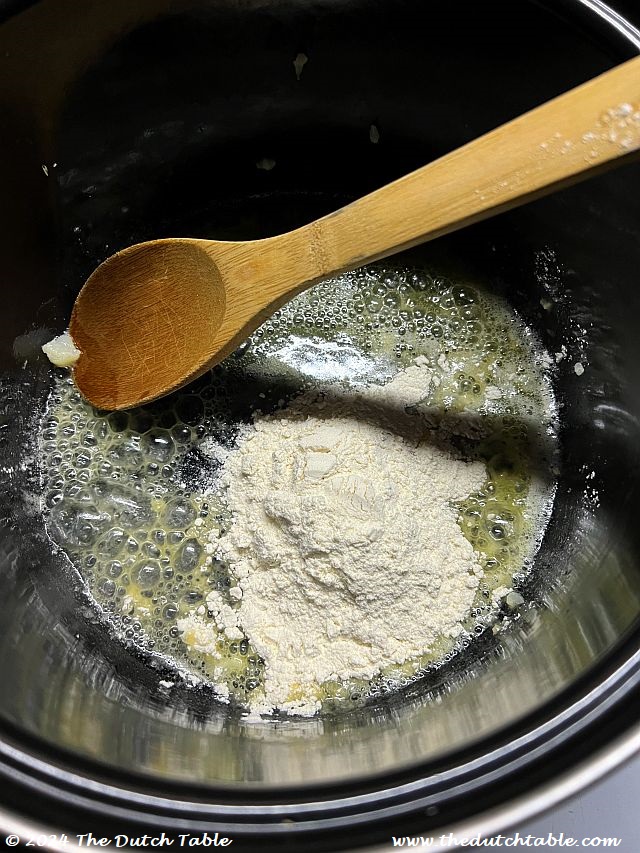
When it's the right texture, drain the cauliflower, but save the water, and measure out two cups (500 ml). (Don't discard the rest of the cooking water if you are planning on making soup with the leftovers). Put the empty cooking pot back on the stove, and in it, melt the butter (do not brown) for the sauce. With a wooden spoon, stir in the flour until the two have come together as a paste, and slowly add the two cups of milk or cooking liquid, while stirring. Keep stirring until the lumps are gone and the sauce has thickened and is hot. Fold in half of the cheese. Bring up to taste with salt and pepper and if desired, a pinch of nutmeg. 

Add the cauliflower back into the pot with the sauce, stir once or twice so that the vegetable is covered with the sauce. 

Heat the oven to 375F/190C. Butter a baking dish (8 x 11 inches/20 x 28 cm) with a little bit of the butter for the gratin, and pour in the hot cauliflower. Give the baking dish one or two shakes so that the contents distribute evenly over the dish. Mix the breadcrumbs with the rest of the cheese, and sprinkle it over the cauliflower. Cut the rest of the butter in small pats or strips and place them strategically on the breadcrumbs. Set the baking dish on the middle rack of the hot oven, and bake for ten to twelve minutes, or until the butter has melted and the breadcrumbs are golden. If you want, you can finish the dish under the broiler during the last minute or so - the melted butter will brown the breadcrumbs nicely - but do not walk away as it will burn quickly. 

Serve with boiled potatoes and gehaktballen, meatballs, or braadworst, bratwurst. A side of appelmoes, applesauce, is also tasty. This dish lends itself perfectly for a typical Dutch practice: prakken. :-)


*If you would rather not use flour, use cornstarch to make a slurry and bind the sauce.
** Use a sharp cheese, like mature cheddar, Gouda or pepperjack cheese.